Kenya's goons: a world of political violence and desperation / Photo: © AFP

 London
 21 °C
21 °C

 Manchester
 19 °C
19 °C
 Glasgow
20 °C
Glasgow
20 °C
 Dublin
 16 °C
16 °C
 Belfast
 16 °C
16 °C
 Washington
26 °C
Washington
26 °C
 Denver
16 °C
Denver
16 °C
 Atlanta
29 °C
Atlanta
29 °C
 Dallas
31 °C
Dallas
31 °C
 Houston Texas
33 °C
Houston Texas
33 °C
 New Orleans
 32 °C
32 °C
 El Paso
22 °C
El Paso
22 °C
 Phoenix
26 °C
Phoenix
26 °C
 Los Angeles
25 °C
San Diego
25 °C
San Francisco
22 °C
Chicago
17 °C
Minneapolis
19 °C
Seattle
13 °C
Portland
17 °C
Salt Lake City
20 °C
Las Vegas
28 °C
Miami
26 °C
Jacksonville
30 °C
San Antonio
31 °C
Bermuda
29 °C
Nassau
22 °C
Iqaluit
4 °C
Yellowknife
5 °C
Anchorage
3 °C
Fairbanks
1 °C
Barrow
Los Angeles
25 °C
San Diego
25 °C
San Francisco
22 °C
Chicago
17 °C
Minneapolis
19 °C
Seattle
13 °C
Portland
17 °C
Salt Lake City
20 °C
Las Vegas
28 °C
Miami
26 °C
Jacksonville
30 °C
San Antonio
31 °C
Bermuda
29 °C
Nassau
22 °C
Iqaluit
4 °C
Yellowknife
5 °C
Anchorage
3 °C
Fairbanks
1 °C
Barrow
 -3 °C
Calgary
11 °C
Edmonton
30 °C
Winnipeg
14 °C
Goose Bay
20 °C
Halifax
19 °C
Boston
20 °C
Ottawa
16 °C
Toronto
21 °C
Detroit
22 °C
Cleveland
24 °C
New York
23 °C
Baltimore
25 °C
Philadelphia
24 °C
Nuuk (Godthåb)
2 °C
Hong Kong
-3 °C
Calgary
11 °C
Edmonton
30 °C
Winnipeg
14 °C
Goose Bay
20 °C
Halifax
19 °C
Boston
20 °C
Ottawa
16 °C
Toronto
21 °C
Detroit
22 °C
Cleveland
24 °C
New York
23 °C
Baltimore
25 °C
Philadelphia
24 °C
Nuuk (Godthåb)
2 °C
Hong Kong
 29 °C
Singapore
26 °C
Melbourne
30 °C
Canberra
8 °C
Adelaide
18 °C
Darwin
29 °C
Singapore
26 °C
Melbourne
30 °C
Canberra
8 °C
Adelaide
18 °C
Darwin
 24 °C
Perth
12 °C
Fort Worth
31 °C
Honolulu
24 °C
Sydney
15 °C
Johannesburg
11 °C
Dubai
24 °C
Perth
12 °C
Fort Worth
31 °C
Honolulu
24 °C
Sydney
15 °C
Johannesburg
11 °C
Dubai
 34 °C
Mumbai
27 °C
Zürich
24 °C
Tokyo
19 °C
Seoul
17 °C
Delhi
26 °C
Beijing
15 °C
Riyadh
35 °C
Prague
19 °C
Pennsylvania
24 °C
Valletta
24 °C
Manama
34 °C
Warsaw
17 °C
Stockholm
14 °C
34 °C
Mumbai
27 °C
Zürich
24 °C
Tokyo
19 °C
Seoul
17 °C
Delhi
26 °C
Beijing
15 °C
Riyadh
35 °C
Prague
19 °C
Pennsylvania
24 °C
Valletta
24 °C
Manama
34 °C
Warsaw
17 °C
Stockholm
14 °C
Kenyan politicians are hiring armed thugs for as little as $4 per day, as poverty and ruthless political competition threaten to unleash uncontrollable violence ahead of elections next year.
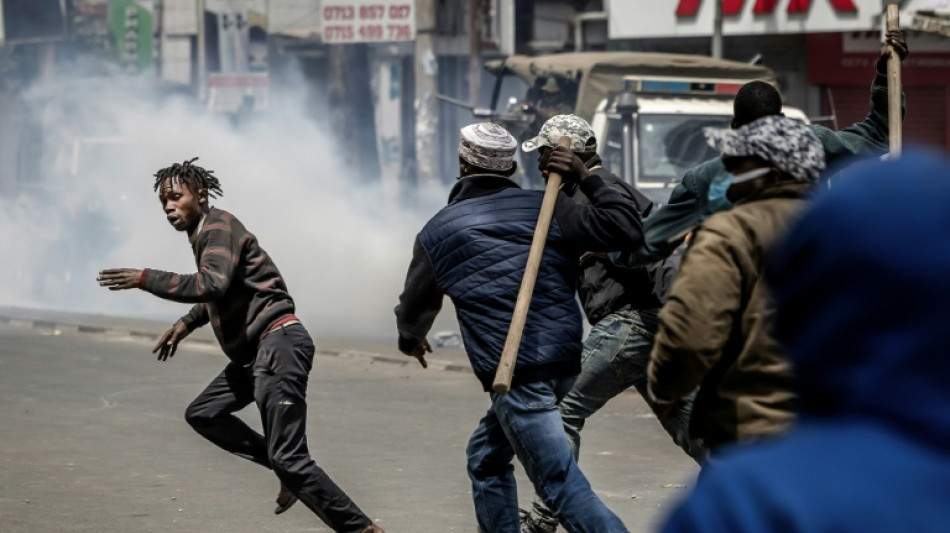
So-called "goons" are increasingly being hired, dozens or even hundreds at a time, to break up the rallies of political opponents and protesters, and attack civil rights groups -- with police often turning a blind eye.
A recent study by Nairobi-based research firm Odipo Dev revealed a goons rate card, ranging from 500 shillings ($4) to work for a local councillor to as much as 1,000 shillings for members of parliament.
Marius, 27, one of five goons who agreed to speak with AFP on condition that their names were changed, has been doing the job since he was 17.
He lost five teeth in a brawl when a politician paid him to protest the opening of a hospital by a rival.
Talking to AFP, he initially insisted: "I'm a goon, and I'm proud to say that."
But his bravura weakened as the conversation continued, and he spoke of his lost dream of being a surgeon, thwarted because his family could not afford school fees.
Raised by a single mother in Korogocho, one of Nairobi's poorest informal settlements, Marius describes himself as "something like illiterate", and sees few options in a country where 40 percent live below the poverty line.
"You end up being a goon to at least earn something," he said.
Marius has a son he no longer sees, he admitted: "I don't want to expose him to the bad things I do. I don't want him to follow in my shoes."
- Official collusion -
Politicians and police insist they want to stamp out "goonism", but analysts say it is deeply entrenched on all sides.
During anti-government protests last year, AFP saw first-hand how hundreds of goons appeared to work directly alongside police to attack demonstrators, later looting and vandalising businesses in central Nairobi.
Last month, CCTV footage seen by AFP showed uniformed officers moving alongside an armed gang as they swarmed into the well-known All Saints Church in Nairobi, violently interrupting a civil rights meeting.
This month, an opposition rally in southwest Kenya was overwhelmed by armed men, leaving one dead, and severalwounded. Videos showed police watching impassively on the sidelines.
Police spokesperson Michael Muchiri told AFP that claims the force works alongside goons are "preposterous", suggesting the above incidents involved rogue officers who were now under investigation.
"The (National Police Service) is determined to ensure the 'goon culture' does not gain a foothold in this country," Muchiri said.
But analysts say politicians on all sides hire thugs, often because they cannot count on police to protect them.
"There is a policing gap... and politicians feel the need to have this machinery either to defend themselves or to intimidate their opponents," said Odipo Dev researcher Darius Okolla
- History of violence -
Goonism has deep and poisonous roots.
In the 1990s, authoritarian president Daniel arap Moi established the Youth for Kanu '92 (YK'92) to rally support for elections, and was accused of bribing voters and fomenting violence.
A key YK'92 organiser was William Ruto, now Kenya's president.
Ruto was charged with crimes against humanity by the International Criminal Court for his part in election violence in 2007-08, though the case stalled following alleged witness intimidation.
Since Ruto won the presidency in 2022, the use of goons is again at its "peak", said Marius, as the government has cracked down on massive youth-led protests sparked by economic hardship and corruption.
"The goons were used to put them down," said Marius. "The goon rate has increased highly because (Ruto) likes operations like that."
The government did not respond to AFP's requests for comment for this article.
"If this trend continues, it is evident that Kenya will not have free, fair, and peaceful elections" in August 2027, said Hussein Khalid, of rights group Vocal Africa.
- Locked out -
Goonism is driven by desperation in an economy where some 800,000 enter the labour market each year for just 100,000 jobs in the formal sector, according to the World Bank.
Daniel, 28, did his best.
A former altar boy, he grew up as one of seven children in Nairobi informal settlements, and his parents scraped together enough to send him to school and university, where he studied criminology.
But in Kenya, one often also needs connections and money to "buy" a first job, which they lacked.
"They say education is the key, but honestly speaking we never find the padlock open," Daniel told AFP.
Wearing overalls and a cap emblazoned with "Billionaire's Boys Club", he expresses profound regret over the seven years he has worked as a goon.
"You find that you have even hit a woman... that woman is like my mother. But you had no option," he said.
His handlers buy booze and drugs to dull the self-loathing.
"In a sober mind, it's not easy," he said.
Daniel veers between shame and dark pragmatism. He knows politicians use him "like tissue paper", but is still grateful for the cash.
"We are counting ourselves rich in the (coming) months because the (election) campaigns will be open," he said.
"At least we can benefit: we can get phones, come back with cash we are promised by these leaders."
Goons also earn a gangster-like respect in their neighbourhoods.
"We are heroes to these kids," said Daniel.
- 'Top gear' -
Goons are hired offline through neighbourhood contacts to avoid leaving any electronic fingerprints. Potential recruits are told to gather in a location, dressed in black, with a face-covering.
Payments are made in cash. One man told AFP the notes were often "new".
They work in groups of 20-50, shepherded by a leader. The most daring, the most violent, the "person in the top gear", as one 23-year-old put it, has a chance -- albeit slim -- of rising through the ranks.
The hope is to become a "big fish" who mediates between the grunts and those with cash, maybe even entering polite society.
Multiple interviewees mentioned famous youth organiser Calvince "Gaucho" Okoth, who has denied being a "goon" but was often linked to violent mobilisations. Last month, he was named to the board of a hospital by Nairobi governor Jonathan Sakaja.
"Someone like Gaucho was once a big fish. Now he's a shark," said Daniel.
The interviewees cared little for the politicians they are paid to support. Some openly disliked Ruto.
"In Kibera (one of Nairobi's biggest slums), what you usually say: your money is not you," said David, 23.
But the concerns of rights groups and protesters -- many drawn from middle-class backgrounds -- also seem distant and abstract.
"If we side with them, we will not be employed," said Marius.
The goons see how politicians behave and think it only right to have their share.
"Each and every youth is interested in that activity because if you can't beat them, then join them," said Daniel.
N. Lebedew--BTZ