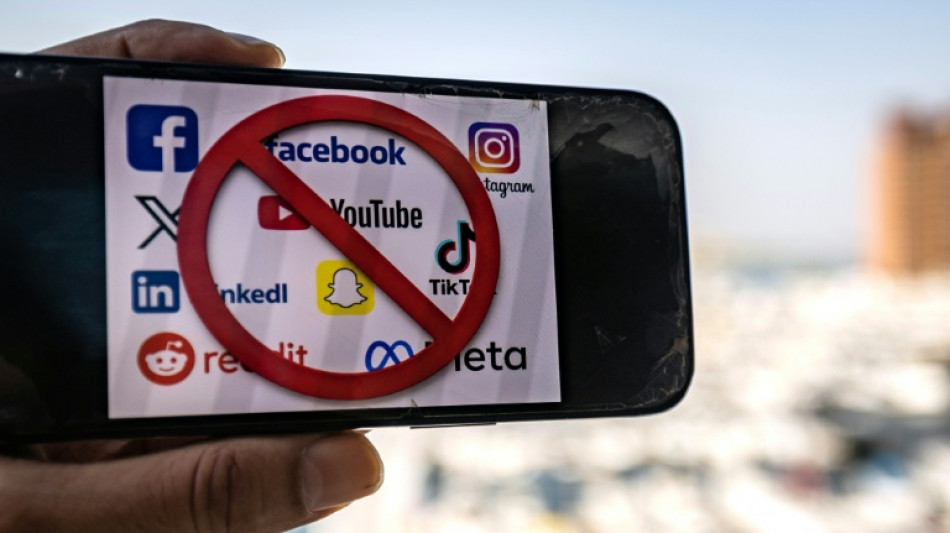
EU to limit children's access to social media -- gradually / Photo: © AFP/File

 London
 15 °C
15 °C

 Manchester
16 °C
Manchester
16 °C
 Glasgow
 11 °C
11 °C
 Dublin
12 °C
Dublin
12 °C
 Belfast
11 °C
Belfast
11 °C
 Washington
30 °C
Washington
30 °C
 Denver
 28 °C
28 °C
 Atlanta
28 °C
Atlanta
28 °C
 Dallas
27 °C
Dallas
27 °C
 Houston Texas
 32 °C
32 °C
 New Orleans
29 °C
New Orleans
29 °C
 El Paso
 22 °C
22 °C
 Phoenix
35 °C
Phoenix
35 °C
 Los Angeles
35 °C
San Diego
38 °C
San Francisco
22 °C
Chicago
18 °C
Minneapolis
17 °C
Seattle
21 °C
Portland
25 °C
Salt Lake City
29 °C
Las Vegas
35 °C
Miami
Los Angeles
35 °C
San Diego
38 °C
San Francisco
22 °C
Chicago
18 °C
Minneapolis
17 °C
Seattle
21 °C
Portland
25 °C
Salt Lake City
29 °C
Las Vegas
35 °C
Miami
 30 °C
Jacksonville
26 °C
San Antonio
26 °C
Bermuda
27 °C
Nassau
26 °C
Iqaluit
3 °C
Yellowknife
8 °C
Anchorage
5 °C
Fairbanks
0 °C
Barrow
-2 °C
Calgary
19 °C
Edmonton
22 °C
Winnipeg
18 °C
Goose Bay
18 °C
Halifax
24 °C
Boston
26 °C
Ottawa
19 °C
Toronto
18 °C
Detroit
19 °C
Cleveland
17 °C
New York
28 °C
Baltimore
30 °C
Philadelphia
29 °C
Nuuk (Godthåb)
30 °C
Jacksonville
26 °C
San Antonio
26 °C
Bermuda
27 °C
Nassau
26 °C
Iqaluit
3 °C
Yellowknife
8 °C
Anchorage
5 °C
Fairbanks
0 °C
Barrow
-2 °C
Calgary
19 °C
Edmonton
22 °C
Winnipeg
18 °C
Goose Bay
18 °C
Halifax
24 °C
Boston
26 °C
Ottawa
19 °C
Toronto
18 °C
Detroit
19 °C
Cleveland
17 °C
New York
28 °C
Baltimore
30 °C
Philadelphia
29 °C
Nuuk (Godthåb)
 5 °C
Hong Kong
25 °C
Singapore
27 °C
Melbourne
28 °C
Canberra
13 °C
Adelaide
11 °C
Darwin
24 °C
Perth
11 °C
Fort Worth
26 °C
Honolulu
29 °C
Sydney
18 °C
Johannesburg
14 °C
Dubai
33 °C
Mumbai
30 °C
Zürich
18 °C
Tokyo
19 °C
Seoul
9 °C
Delhi
24 °C
Beijing
5 °C
Hong Kong
25 °C
Singapore
27 °C
Melbourne
28 °C
Canberra
13 °C
Adelaide
11 °C
Darwin
24 °C
Perth
11 °C
Fort Worth
26 °C
Honolulu
29 °C
Sydney
18 °C
Johannesburg
14 °C
Dubai
33 °C
Mumbai
30 °C
Zürich
18 °C
Tokyo
19 °C
Seoul
9 °C
Delhi
24 °C
Beijing
 11 °C
Riyadh
31 °C
Prague
12 °C
Pennsylvania
25 °C
Valletta
24 °C
Manama
33 °C
Warsaw
11 °C
Stockholm
14 °C
11 °C
Riyadh
31 °C
Prague
12 °C
Pennsylvania
25 °C
Valletta
24 °C
Manama
33 °C
Warsaw
11 °C
Stockholm
14 °C
Children should have "phased and gradual access" to social media, EU chief Ursula von der Leyen said Monday, as experts recommended under 13s only use online platforms under supervision.
The European Union has been mulling a social media ban since a push by EU states, inclouding Greece and France, for limiting access, with pressure intensifying for a bloc-wide ban like Australia.
To help the EU take decisions based on evidence, von der Leyen tasked an expert panel of doctors, academics, youth representatives and parents to advise the bloc. They delivered their recommendations Monday.
"What we already have is a consensus that there needs to be a start date for the age children can join social media," von der Leyen said, calling for "age-appropriate restrictions".
"This is not about whether children can access social media. It is about whether and when social media can access our children," she said.
A legal proposal will come in the second half of the year, von der Leyen added.
"We need to consider a phased and gradual access for different age ranges," she said.
The experts' report offered a glimpse of how that could look as they recommended:
-- No screens at all for babies and toddlers;
-- Supervised use of "age-appropriate social media" and devices children aged between three and 12;
-- For those aged 13 to 18, "evolving autonomous use" of social media and other digital platforms that have "key safety features".
Platforms "must prove that their services do no harm. In Europe, whoever develops a product is responsible for its safety", von der Leyen said.
"An entire ecosystem around children has to change. But we do not have time. Children and adolescents are facing serious risks right now," one of the panel's co-chairs Jorg Fegert said, standing beside von der Leyen.
The report did not recommend a blanket ban on digital platforms including social media, and von der Leyen did not back such a move.
The EU has ramped up the pressure on social media platforms to change in recent months, telling Facebook and Instagram Friday to dismantle their "addictive" features, after a similar warning to TikTok in February.
- Targeting harmful design -
A dilemma for the EU is how to avoid different age limits across 27 countries. For example, Spain wants to ban under-16s accessing social networks, while France proposes prohibiting children aged 15 and under.
And then there are EU nations such as Estonia that oppose a ban.
Von der Leyen said the European Commission, the EU's executive arm, would "have a very careful look" at the national proposals.
The EU will "integrate" their work, she said, and then prepare its own proposal to "harmonise the approach and to find a common solution".
The EU already has a bolstered armoury to rein in Big Tech and protect users online, and the commission has said more rules are on the way.
EU consumer protection chief Michael McGrath vowed a new law, expected later this year, will give children stronger protection against addictive design.
"Digital markets are designed to capture attention and influence behaviour. The new rules will help ensure consumers can make informed choices free from manipulation," McGrath said in a statement to AFP.
L. Solowjow--BTZ