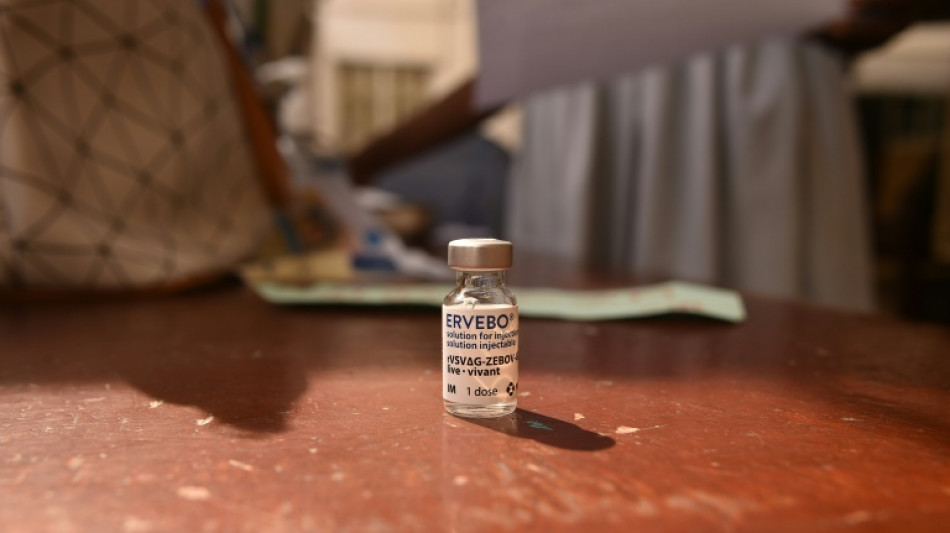
WHO urges Ervebo vaccine trial in DR Congo Ebola outbreak / Photo: © AFP

 London
 25 °C
25 °C
 Manchester
23 °C
Manchester
23 °C
 Glasgow
 18 °C
18 °C
 Dublin
19 °C
Dublin
19 °C
 Belfast
20 °C
Belfast
20 °C
 Washington
 16 °C
16 °C
 Denver
17 °C
Denver
17 °C
 Atlanta
26 °C
Atlanta
26 °C
 Dallas
 30 °C
30 °C
 Houston Texas
31 °C
Houston Texas
31 °C
 New Orleans
28 °C
New Orleans
28 °C
 El Paso
 24 °C
24 °C
 Phoenix
29 °C
Phoenix
29 °C
 Los Angeles
20 °C
San Diego
22 °C
San Francisco
14 °C
Chicago
15 °C
Minneapolis
14 °C
Seattle
14 °C
Portland
15 °C
Salt Lake City
16 °C
Las Vegas
22 °C
Miami
30 °C
Jacksonville
30 °C
San Antonio
29 °C
Bermuda
30 °C
Nassau
17 °C
Iqaluit
2 °C
Yellowknife
8 °C
Anchorage
4 °C
Fairbanks
3 °C
Barrow
Los Angeles
20 °C
San Diego
22 °C
San Francisco
14 °C
Chicago
15 °C
Minneapolis
14 °C
Seattle
14 °C
Portland
15 °C
Salt Lake City
16 °C
Las Vegas
22 °C
Miami
30 °C
Jacksonville
30 °C
San Antonio
29 °C
Bermuda
30 °C
Nassau
17 °C
Iqaluit
2 °C
Yellowknife
8 °C
Anchorage
4 °C
Fairbanks
3 °C
Barrow
 2 °C
Calgary
17 °C
Edmonton
21 °C
Winnipeg
14 °C
Goose Bay
14 °C
Halifax
16 °C
Boston
17 °C
Ottawa
13 °C
Toronto
15 °C
Detroit
14 °C
Cleveland
16 °C
New York
17 °C
Baltimore
15 °C
Philadelphia
16 °C
Nuuk (Godthåb)
4 °C
Hong Kong
28 °C
Singapore
25 °C
Melbourne
29 °C
Canberra
9 °C
Adelaide
2 °C
Calgary
17 °C
Edmonton
21 °C
Winnipeg
14 °C
Goose Bay
14 °C
Halifax
16 °C
Boston
17 °C
Ottawa
13 °C
Toronto
15 °C
Detroit
14 °C
Cleveland
16 °C
New York
17 °C
Baltimore
15 °C
Philadelphia
16 °C
Nuuk (Godthåb)
4 °C
Hong Kong
28 °C
Singapore
25 °C
Melbourne
29 °C
Canberra
9 °C
Adelaide
 13 °C
Darwin
25 °C
Perth
13 °C
Darwin
25 °C
Perth
 14 °C
Fort Worth
29 °C
Honolulu
25 °C
Sydney
15 °C
Johannesburg
23 °C
Dubai
35 °C
Mumbai
30 °C
Zürich
21 °C
Tokyo
25 °C
Seoul
20 °C
Delhi
30 °C
Beijing
22 °C
Riyadh
37 °C
Prague
15 °C
Pennsylvania
14 °C
Valletta
28 °C
Manama
35 °C
Warsaw
15 °C
Stockholm
15 °C
14 °C
Fort Worth
29 °C
Honolulu
25 °C
Sydney
15 °C
Johannesburg
23 °C
Dubai
35 °C
Mumbai
30 °C
Zürich
21 °C
Tokyo
25 °C
Seoul
20 °C
Delhi
30 °C
Beijing
22 °C
Riyadh
37 °C
Prague
15 °C
Pennsylvania
14 °C
Valletta
28 °C
Manama
35 °C
Warsaw
15 °C
Stockholm
15 °C
WHO vaccine experts on Friday recommended a full-scale human trial of the only existing approved Ebola vaccine to see if it offers cross-protection against the strain spreading in the DR Congo.
The Ervebo vaccine has proven safe and efficacious against the more common Zaire strain of Ebola virus, and World Health Organization experts said early data, notably from animal trials, showed it may offer a degree of cross-protection against the rare Bundibugyo strain exploding in the DRC.
The recommendation came as the number of confirmed cases in the Democratic Republic of Congo hit 4,053, including 1,850 fatalities.
WHO officials have repeatedly warned the virus is spreading faster than response efforts can catch up.
The UN health agency's technical advisory group on candidate vaccine prioritisation (TAG-CVP) for the Bundibugyo outbreak response met last week to review new data that has emerged since their meeting in May, in the days following the outbreak declaration.
"The members recommended Ervebo, the only licensed Ebola vaccine, be prioritised for inclusion in a randomised clinical trial in the context of the ongoing outbreak," a WHO statement said.
The experts looked at several studies, including one which showed that three out of four non-human primates vaccinated with Ervebo survived Bundibugyo, compared with one out of four control animals.
They also looked at an as-yet unpublished study on ferrets which found that the research-grade version of Ervebo provided 100-percent protection against Bundibugyo, whereas all control animals died within 10 days.
- Managing expectations -
The TAG-CVP experts unanimously agreed that there were no safety concerns about using Ervebo in a clinical research study vaccinating contacts of cases, noting that it is already licensed by regulatory agencies and has been given to hundreds of thousands of people in Africa.
"Expectations need to be managed about its likely protective effect if used in a Phase III ring vaccination trial as efficacy against symptomatic disease and transmission may not be high, whereas protection against a fatal outcome may be achieved," their meeting report said.
Final-stage Phase III trials of potential drugs of vaccines typically involve hundreds to thousands of people.
Given the wealth of data on Ervebo, "it could enter a Phase III trial without an initial Phase II evaluation", the WHO experts said.
Nonetheless, a specific Bundibugyo vaccine remains the preferred option for fighting the current outbreak, they stressed.
Two potential Bundibugyo vaccines are in the early stages of clinical trials -- testing on humans -- while a third is also being worked on to bring it to that stage.
Ebola is spread by contact with bodily fluids and causes a haemorrhagic fever. It has killed more than 15,000 people in Africa in the last 50 years.
The case fatality rate in the DRC in the current outbreak is 46 percent.
I. Johansson--BTZ