The Sourdough Sidekick Review: Can an Automated Feeder Save Your Starter?

 London
 9 °C

 Manchester
 10 °C
 Glasgow
 9 °C
 Dublin
 12 °C
 Belfast
11 °C
 Washington
13 °C
 Denver
 8 °C
 Atlanta
10 °C
 Dallas
 14 °C
 Houston Texas
16 °C
 New Orleans
15 °C
 El Paso
12 °C
 Phoenix
17 °C
 Los Angeles
20 °C
San Diego
18 °C
San Francisco
14 °C
Chicago
6 °C
Minneapolis
5 °C
Seattle
 7 °C
Portland
8 °C
Salt Lake City
9 °C
Las Vegas
12 °C
Miami
26 °C
Jacksonville
16 °C
San Antonio
 14 °C
Bermuda
23 °C
Nassau
11 °C
Iqaluit
-6 °C
Yellowknife
 -3 °C
Anchorage
-2 °C
Fairbanks
 -7 °C
Barrow
-9 °C
Calgary
2 °C
Edmonton
8 °C
Winnipeg
3 °C
Goose Bay
8 °C
Halifax
10 °C
Boston
10 °C
Ottawa
8 °C
Toronto
7 °C
Detroit
7 °C
Cleveland
9 °C
New York
12 °C
Baltimore
13 °C
Philadelphia
12 °C
Nuuk (Godthåb)
2 °C
Hong Kong
21 °C
Singapore
26 °C
Melbourne
23 °C
Canberra
5 °C
Adelaide
 22 °C
Darwin
30 °C
Perth
17 °C
Fort Worth
13 °C
Honolulu
23 °C
Sydney
15 °C
Johannesburg
22 °C
Dubai
32 °C
Mumbai
32 °C
Zürich
9 °C
Tokyo
11 °C
Seoul
4 °C
Delhi
24 °C
Beijing
5 °C
Riyadh
28 °C
Prague
3 °C
Pennsylvania
13 °C
Valletta
22 °C
Manama
28 °C
Warsaw
6 °C
Stockholm
5 °C
Maintaining a sourdough starter as a working parent can feel like caring for another pet. To address this challenge, King Arthur Baking Company and GE Appliances developed the Sourdough Sidekick, an automated feeder that dispenses flour and water on a schedule. After three weeks of testing, the device successfully ended a yearlong baking dry spell, though it requires careful initial setup to function correctly.
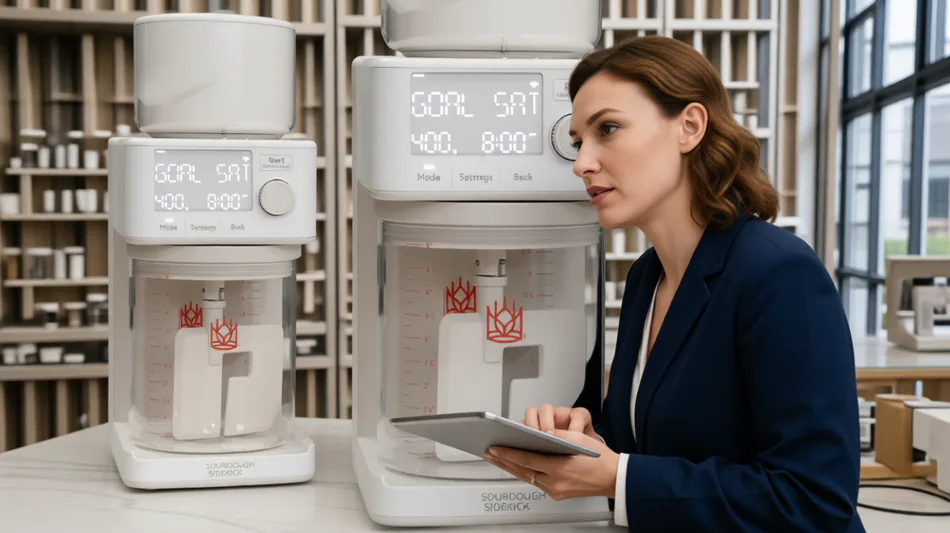
The Sourdough Sidekick, a collaboration between King Arthur Baking Company and FirstBuild, GE Appliances’ product development lab, has arrived as an automated solution for one of home baking’s most persistent chores: keeping a sourdough starter alive. For individuals who enjoy baking but lack the time or consistency to maintain a living culture, the device promises to dispense flour and water on a set schedule, effectively acting as a mechanical caretaker.
The premise addresses a common pain point for home bakers. Maintaining a sourdough starter often feels akin to caring for a pet that demands regular attention. While starters can be stored in refrigeration for about a week between bakes, reviving them typically requires days of feeding cycles. For full-time working parents or busy professionals, remembering these weekly tasks is difficult. The Sidekick aims to remove this friction by automating the process entirely.
The device resembles a Mr. Coffee-sized appliance, featuring a built-in water reservoir, a flour hopper at the top, and a glass crock with a stirring-paddle lid. It operates using GE’s SmartHQ ecosystem, though the accompanying mobile application is optional. The reviewer in this assessment chose not to download the app, relying instead on the device’s onboard controls and the included Quick Start Guide.
Initial setup involves filling the water reservoir and flour hopper, setting the current day and time, and programming the desired start date for the starter’s readiness—users can schedule up to seven days in advance. After adding a small amount of existing seed starter and pressing “Auto Mode,” the machine begins its work. However, early performance was inconsistent. During the first mixing cycle, the device released a torrent of flour but failed to dispense water, resulting in an under-hydrated, dry ball of dough.
The issue persisted for several days until the user removed the crock to manually add water, discovering that the reservoir remained full. Upon finally downloading the app, the reviewer discovered the device required a firmware update. After updating, the Sidekick began dispensing water during mixing cycles. However, further troubleshooting revealed that the machine needed manual calibration using a scale to ensure accurate proportions of flour and water. This calibration process is described as lengthy and fiddly but is theoretically a one-time requirement.
Once properly calibrated, the Sidekick dispenses 30 grams each of water and flour daily and initiates a stirring cycle every two hours. The stirring mechanism produces a loud mechanical whir and an initial beep, which can be startling if the device is in a living space. While users can bypass the frequent stirring via onboard controls, keeping it active helps knock down the starter’s volume and reincorporate unconsumed flour. The updated paddle design effectively mixes the ingredients.
The resulting starter may not exhibit the traditional puffy, bubbly appearance associated with hand-mixed cultures due to the regular mixing and lack of discard in Auto Mode. However, the reviewer notes that the starter should smell tangy and indisputably fermented. Some online users suggest adding rye flour to boost growth, but this did not yield noticeable differences in performance or aroma during testing.
Beyond basic operation, the Sidekick offers additional modes. Ratio Mode allows users to specify feeding ratios, such as 1:1:1 or 1:1:2. Custom Mode provides granular control over exact flour and water quantities and feeding frequency, including twice-daily options. The reviewer utilized Custom Mode most frequently to switch between flour types for different bread varieties. By the end of a typical week, the crock holds approximately two-thirds full, containing over 400 grams of starter—sufficient for two boules, a sandwich loaf, and seed for the next batch.
The device’s app functionality is limited to displaying current settings, sending push notifications when the starter is ready, and facilitating firmware updates. It does not allow remote adjustment of settings. A recent update supports power-loss recovery for up to 12 hours, a feature tested successfully after a household power outage.
Unlike competitor devices such as the Goldie or Brod & Taylor’s Sourdough Home, the Sidekick lacks adjustable temperature controls for the starter itself. It does, however, display ambient temperature and uses this data in Auto Mode to adjust feeding amounts based on room conditions. This “temperature-aware” feature may mitigate some issues in cold kitchens, though it cannot actively warm the culture.
The resulting bread showed no discernible difference from loaves made with traditionally maintained starters. If baking is not immediate, the starter can be discarded or stored in the refrigerator using the included metal lid. Excess starter can be used in recipes or gifted to others. Users switching flour types must recalibrate the machine.
Priced significantly higher than a spoon and a Mason jar, the Sourdough Sidekick is not a necessity for experienced bakers. However, for those intimidated by the maintenance process or lacking the time for it, the device offers a compelling solution. After three weeks of testing, the reviewer concluded that the automation ended a yearlong baking slump, suggesting that without the machine, bread would not have been baked that year.
The device also includes instructions for creating a new starter from scratch within the machine, further lowering the barrier to entry for novice bakers. All removable components are top-rack dishwasher safe, simplifying cleanup. While the initial setup requires patience and attention to detail, the long-term maintenance is largely hands-off.
D. O'Sullivan--BTZ