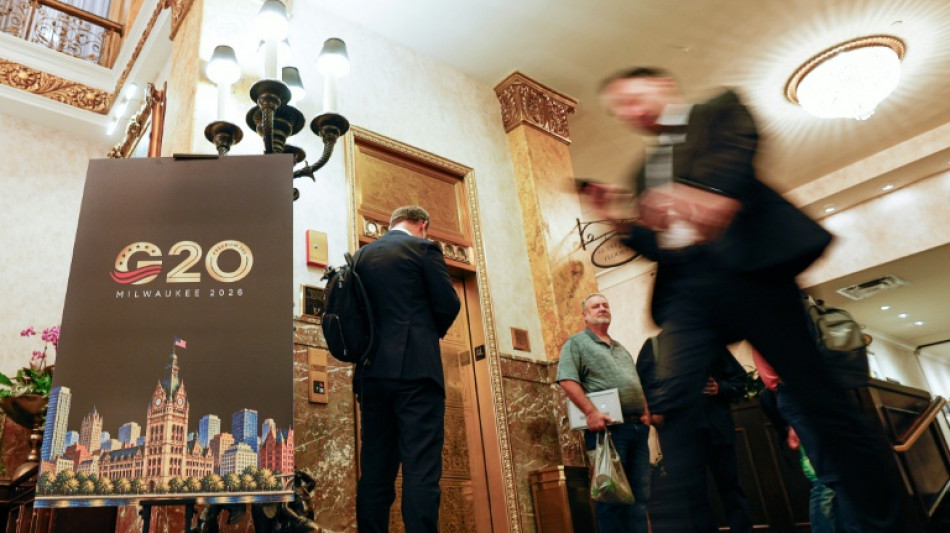
US pushes against overproduction with eye on China at G20 meeting / Photo: © AFP

 London
 21 °C
21 °C
 Manchester
 19 °C
19 °C
 Glasgow
20 °C
Glasgow
20 °C
 Dublin
 16 °C
16 °C
 Belfast
 16 °C
16 °C
 Washington
26 °C
Washington
26 °C
 Denver
16 °C
Denver
16 °C
 Atlanta
29 °C
Atlanta
29 °C
 Dallas
31 °C
Dallas
31 °C
 Houston Texas
33 °C
Houston Texas
33 °C
 New Orleans
 32 °C
32 °C
 El Paso
22 °C
El Paso
22 °C
 Phoenix
26 °C
Phoenix
26 °C
 Los Angeles
25 °C
San Diego
25 °C
San Francisco
22 °C
Chicago
17 °C
Minneapolis
19 °C
Seattle
13 °C
Portland
17 °C
Salt Lake City
20 °C
Las Vegas
28 °C
Miami
26 °C
Jacksonville
30 °C
San Antonio
31 °C
Bermuda
29 °C
Nassau
22 °C
Iqaluit
4 °C
Yellowknife
5 °C
Anchorage
3 °C
Fairbanks
1 °C
Barrow
Los Angeles
25 °C
San Diego
25 °C
San Francisco
22 °C
Chicago
17 °C
Minneapolis
19 °C
Seattle
13 °C
Portland
17 °C
Salt Lake City
20 °C
Las Vegas
28 °C
Miami
26 °C
Jacksonville
30 °C
San Antonio
31 °C
Bermuda
29 °C
Nassau
22 °C
Iqaluit
4 °C
Yellowknife
5 °C
Anchorage
3 °C
Fairbanks
1 °C
Barrow
 -3 °C
Calgary
11 °C
Edmonton
30 °C
Winnipeg
14 °C
Goose Bay
20 °C
Halifax
19 °C
Boston
20 °C
Ottawa
16 °C
Toronto
21 °C
Detroit
22 °C
Cleveland
24 °C
New York
23 °C
Baltimore
25 °C
Philadelphia
24 °C
Nuuk (Godthåb)
2 °C
Hong Kong
-3 °C
Calgary
11 °C
Edmonton
30 °C
Winnipeg
14 °C
Goose Bay
20 °C
Halifax
19 °C
Boston
20 °C
Ottawa
16 °C
Toronto
21 °C
Detroit
22 °C
Cleveland
24 °C
New York
23 °C
Baltimore
25 °C
Philadelphia
24 °C
Nuuk (Godthåb)
2 °C
Hong Kong
 29 °C
Singapore
26 °C
Melbourne
30 °C
Canberra
8 °C
Adelaide
18 °C
Darwin
29 °C
Singapore
26 °C
Melbourne
30 °C
Canberra
8 °C
Adelaide
18 °C
Darwin
 24 °C
Perth
12 °C
Fort Worth
31 °C
Honolulu
24 °C
Sydney
15 °C
Johannesburg
11 °C
Dubai
24 °C
Perth
12 °C
Fort Worth
31 °C
Honolulu
24 °C
Sydney
15 °C
Johannesburg
11 °C
Dubai
 34 °C
Mumbai
27 °C
Zürich
24 °C
Tokyo
19 °C
Seoul
17 °C
Delhi
26 °C
Beijing
15 °C
Riyadh
35 °C
Prague
19 °C
Pennsylvania
24 °C
Valletta
24 °C
Manama
34 °C
Warsaw
17 °C
Stockholm
14 °C
34 °C
Mumbai
27 °C
Zürich
24 °C
Tokyo
19 °C
Seoul
17 °C
Delhi
26 °C
Beijing
15 °C
Riyadh
35 °C
Prague
19 °C
Pennsylvania
24 °C
Valletta
24 °C
Manama
34 °C
Warsaw
17 °C
Stockholm
14 °C
The United States is pushing for action against excess industrial capacity that drives prices down unfairly, Washington's top trade envoy said Wednesday on the sidelines of a G20 meeting, with some countries -- excluding China -- agreeing to a plan that includes lowering subsidies.
The developments came as officials from the Group of 20 major economies convene in the Midwestern city of Milwaukee over two days, with a group of countries agreeing on a framework to counter "persistent" excess steel production.
This is a criticism often levied against China, with accusations that it produces more than it consumes, flooding markets. Beijing rejects these claims.
"We're releasing a Milwaukee framework to take coordinated action on steel excess capacity," top US trade official Jamieson Greer told reporters Wednesday.
"Every country will do what they think is appropriate. We want to coordinate those measures," Greer added. "The United States has taken robust measures, and it probably makes sense for other countries to do that too."
He did not elaborate if he meant for countries to raise trade barriers on Chinese steel.
Greer's comments came after a meeting of the Global Forum on Steel Excess Capacity, whose 28 members include the European Union, Australia, Japan and South Korea -- but not China.
Asked about his message to partners this week on overcapacity, China's international trade representative Li Chenggang told AFP that G20 members had yet to discuss the topic in earnest.
Besides plans to reduce or eliminate "market-distorting subsidies," members of the steel global forum also agreed to boost data sharing to help identify "suspicious patterns of steel trade," according to the framework.
It added that members would also take "trade measures," if needed, on countries that overproduce.
- Few breakthroughs -
G20 trade ministers toured a business in Milwaukee on Wednesday and are set for talks in the afternoon.
But US President Donald Trump's global tariffs cast a pall over their agenda, and have pushed countries to seek cooperation outside the world's biggest economy.
The talks come amid a deepening US-Canada trade war, waves of US tariffs and Trump's investigations into member countries over excess industrial capacity.
Analysts expect few breakthroughs as trade tensions simmer.
Countries are meanwhile seeking deals with the Trump administration, with India pushing to get a trade pact over the finish line.
The G20 trade ministerial comes after finance ministers met in Asheville, setting the stage for a leaders' summit in Miami.
Heading into talks early Wednesday, Polish Finance Minister Andrzej Domanski urged for a lowering of trade barriers.
"I do hope that our US partners will stick to all settlements that were made," he added, referring to an earlier deal between the United States and European Union to cap Trump's duties on the bloc at 15 percent.
Ongoing US investigations into overcapacity target 16 trading partners including China, the EU, Japan and India -- bringing the threat of additional tariffs even to those who earlier struck agreements.
Poland is not a permanent G20 member but has been invited to the table this year as Washington holds the grouping's rotating presidency. In turn, US officials have excluded South Africa.
Also on the agenda this week are efforts to eliminate forced labor in supply chains and the targeting of access to food supplies to pressure others.
Domanski on Wednesday condemned "all actions taken by Russia against the export of agriculture products from Ukraine," as Moscow and Kyiv remain at war after Russia's 2022 invasion.
Asked about existing deals to cut tariffs imposed by Trump in his second presidency, Greer told reporters Tuesday: "We will certainly take them into account."
On reaching a pact with Canada, where certain products now face a US ban due to their trade spat, Greer added: "It's not urgent for us."
"At some point will there be a deal? I mean, presumably," he said. "Eventually, it will happen."
The G20 comprises 19 nations plus the EU and the African Union.
I. Johansson--BTZ