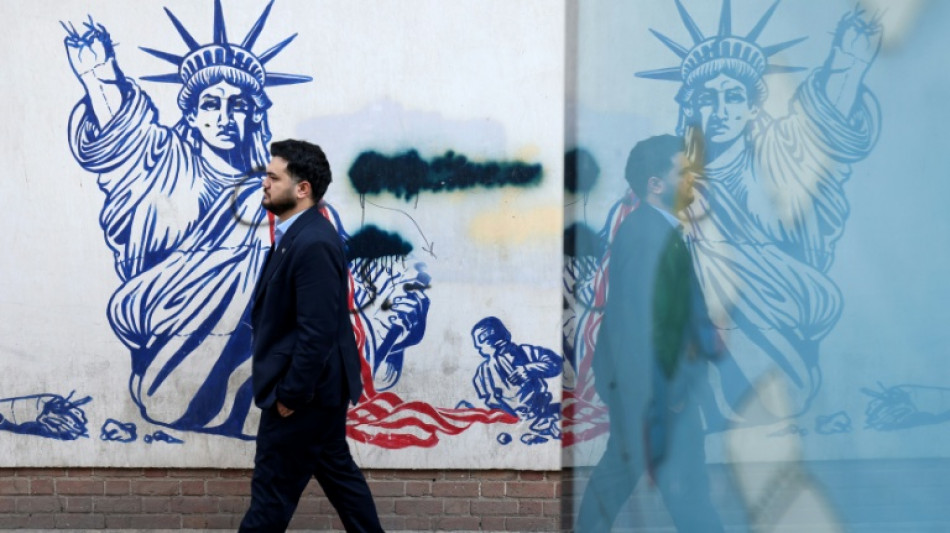
Iran's Khamenei likens protests to 'coup', warns of regional war / Photo: © AFP

 London
 13 °C
13 °C
 Manchester
 14 °C
14 °C
 Glasgow
 15 °C
15 °C
 Dublin
15 °C
Dublin
15 °C
 Belfast
12 °C
Belfast
12 °C
 Washington
19 °C
Washington
19 °C
 Denver
 14 °C
14 °C
 Atlanta
21 °C
Atlanta
21 °C
 Dallas
23 °C
Dallas
23 °C
 Houston Texas
 25 °C
25 °C
 New Orleans
26 °C
New Orleans
26 °C
 El Paso
 19 °C
19 °C
 Phoenix
27 °C
Phoenix
27 °C
 Los Angeles
21 °C
San Diego
21 °C
San Francisco
14 °C
Chicago
16 °C
Minneapolis
8 °C
Seattle
13 °C
Portland
16 °C
Salt Lake City
17 °C
Las Vegas
24 °C
Miami
27 °C
Jacksonville
24 °C
San Antonio
23 °C
Bermuda
25 °C
Nassau
19 °C
Iqaluit
3 °C
Yellowknife
4 °C
Anchorage
Los Angeles
21 °C
San Diego
21 °C
San Francisco
14 °C
Chicago
16 °C
Minneapolis
8 °C
Seattle
13 °C
Portland
16 °C
Salt Lake City
17 °C
Las Vegas
24 °C
Miami
27 °C
Jacksonville
24 °C
San Antonio
23 °C
Bermuda
25 °C
Nassau
19 °C
Iqaluit
3 °C
Yellowknife
4 °C
Anchorage
 2 °C
Fairbanks
-1 °C
Barrow
-8 °C
Calgary
7 °C
Edmonton
23 °C
Winnipeg
4 °C
Goose Bay
18 °C
Halifax
18 °C
Boston
20 °C
Ottawa
17 °C
Toronto
17 °C
Detroit
16 °C
Cleveland
24 °C
New York
21 °C
Baltimore
19 °C
Philadelphia
19 °C
Nuuk (Godthåb)
1 °C
Hong Kong
31 °C
Singapore
2 °C
Fairbanks
-1 °C
Barrow
-8 °C
Calgary
7 °C
Edmonton
23 °C
Winnipeg
4 °C
Goose Bay
18 °C
Halifax
18 °C
Boston
20 °C
Ottawa
17 °C
Toronto
17 °C
Detroit
16 °C
Cleveland
24 °C
New York
21 °C
Baltimore
19 °C
Philadelphia
19 °C
Nuuk (Godthåb)
1 °C
Hong Kong
31 °C
Singapore
 33 °C
Melbourne
28 °C
Canberra
14 °C
Adelaide
16 °C
Darwin
32 °C
Perth
33 °C
Melbourne
28 °C
Canberra
14 °C
Adelaide
16 °C
Darwin
32 °C
Perth
 23 °C
Fort Worth
23 °C
Honolulu
26 °C
Sydney
20 °C
Johannesburg
14 °C
Dubai
37 °C
Mumbai
36 °C
Zürich
15 °C
Tokyo
20 °C
Seoul
22 °C
Delhi
35 °C
Beijing
23 °C
Riyadh
39 °C
Prague
13 °C
Pennsylvania
17 °C
Valletta
24 °C
Manama
35 °C
Warsaw
15 °C
Stockholm
15 °C
23 °C
Fort Worth
23 °C
Honolulu
26 °C
Sydney
20 °C
Johannesburg
14 °C
Dubai
37 °C
Mumbai
36 °C
Zürich
15 °C
Tokyo
20 °C
Seoul
22 °C
Delhi
35 °C
Beijing
23 °C
Riyadh
39 °C
Prague
13 °C
Pennsylvania
17 °C
Valletta
24 °C
Manama
35 °C
Warsaw
15 °C
Stockholm
15 °C
Iran's supreme leader on Sunday likened recent anti-government protests to a "coup", warning that any US attack on the Islamic republic following Washington's military deployments in the Middle East would trigger a regional war.
The Iranian authorities' deadly response to the protests sparked threats of intervention from US President Donald Trump, who dispatched an aircraft carrier group to the region.
"The Americans should know that if they start a war, this time it will be a regional war," Ayatollah Ali Khamenei said, telling Iranians they "should not be scared" of Trump's rhetoric.
The demonstrations in Iran began as an expression of discontent at the high cost of living, but grew into a mass anti-government movement that the country's leaders have described as "riots" fomented by the United States and Israel.
"They (rioters) attacked the police, government centres, IRGC centres, banks, and mosques, and burned the Koran... It was like a coup," Khamenei said, adding that "the coup was suppressed".
Tehran has acknowledged more than 3,000 deaths during the protests, but insists that most were members of the security forces and innocent bystanders, attributing the violence to "terrorist acts".
Rights groups and foreign governments, however, have accused Iran and its Islamic Revolutionary Guard Corps (IRGC) of carrying out a crackdown that killed thousands of protesters.
The response prompted the European Union to list the IRGC as a terrorist organisation, with Iranian lawmakers retaliating on Sunday by slapping the same designation on European armies.
Lawmakers wore the green uniform of the Guards in a display of solidarity at the legislative session, where they chanted "Death to America", "Death to Israel" and "Shame on you, Europe", state television footage showed.
Slamming the bloc's "irresponsible action", speaker Mohammad Bagher Ghalibaf said that under "Article 7 of the Law on Countermeasures Against the Declaration of the IRGC as a Terrorist Organisation, the armies of European countries are considered terrorist groups".
It remained unclear what immediate impact the decision would have.
The law was first passed in 2019, when the United States classified the Guards as a terrorist organisation.
Sunday's session was held on the 47th anniversary of the return from exile of the late Ayatollah Ruhollah Khomeini, who founded the Islamic republic in 1979.
The Guards are the ideological arm of Iran's military, tasked with safeguarding the Islamic revolution from external and internal threats.
The European Union agreed on Thursday to list the Guards as a "terrorist organisation" over the response to the protests.
The step matched similar classifications enacted by the United States, Canada and Australia.
Ghalibaf said the decision had "accelerated Europe's path to becoming irrelevant in the future world order", adding it had only increased domestic support for the Guards.
- Threats and dialogue -
Iran and the United States have been trading warnings and threats of potential military action, even as their leaders appear to leave the door open for negotiations.
Firouzeh, a 43-year-old homemaker who declined to give her full name, said the recent tensions had left her "very worried and scared".
"Lately, all I do is watch the news until I fall asleep. Sometimes I wake up in the middle of the night to check the updates."
IRGC official Ahmad Vahidi was quoted by the Mehr news agency as saying "enemies" sought to create a "war atmosphere".
"This is part of their psychological operations. Therefore we should not fall into this trap," Vahidi said.
The ultra-conservative Kayhan daily ran the headline "West Asia, Iran's home and America's graveyard", while Mehr said several thousand graves in Tehran were ready to receive the remains of American soldiers if the United States attacked.
But Ali Larijani, head of Iran's Supreme National Security Council, said on Saturday: "Contrary to the hype of the contrived media war, structural arrangements for negotiations are progressing."
Trump also confirmed that dialogue was taking place, but without withdrawing his earlier threats, adding "we'll see what happens".
The US president previously said he believed Iran would make a deal over its nuclear and missile programmes rather than face military action.
Tehran, meanwhile, has said it is ready for nuclear talks if its missile and defence capabilities are not on the agenda.
Iranian President Masoud Pezeshkian said Saturday that "a war would be in the interest of neither Iran, nor the United States, nor the region", during a call with his Egyptian counterpart, according to his office.
Qatari premier Sheikh Mohammed bin Abdulrahman Al, who also serves as foreign minister, held talks in Iran Saturday to try to "de-escalate tensions", the kingdom's foreign ministry said.
N. Lebedew--BTZ