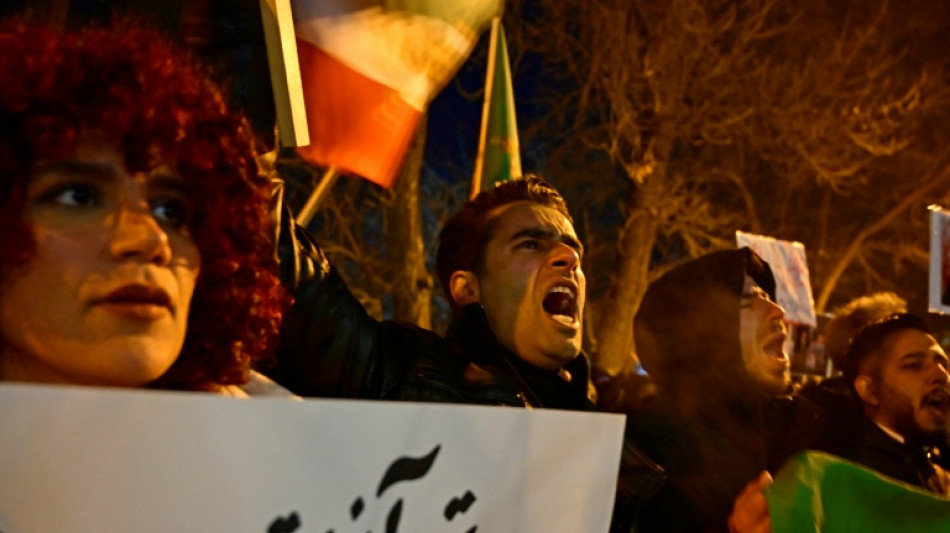
Iran says 3,117 killed during protests, activists fear 'far higher' toll / Photo: © AFP

 London
 21 °C
21 °C
 Manchester
 18 °C
18 °C
 Glasgow
 19 °C
19 °C
 Dublin
17 °C
Dublin
17 °C
 Belfast
 16 °C
16 °C
 Washington
22 °C
Washington
22 °C
 Denver
 11 °C
11 °C
 Atlanta
22 °C
Atlanta
22 °C
 Dallas
22 °C
Dallas
22 °C
 Houston Texas
25 °C
Houston Texas
25 °C
 New Orleans
28 °C
New Orleans
28 °C
 El Paso
17 °C
El Paso
17 °C
 Phoenix
26 °C
Phoenix
26 °C
 Los Angeles
 20 °C
San Diego
20 °C
San Diego
 20 °C
San Francisco
14 °C
Chicago
15 °C
Minneapolis
8 °C
Seattle
13 °C
Portland
12 °C
Salt Lake City
15 °C
Las Vegas
22 °C
Miami
29 °C
Jacksonville
28 °C
San Antonio
24 °C
Bermuda
27 °C
Nassau
22 °C
Iqaluit
4 °C
Yellowknife
4 °C
Anchorage
20 °C
San Francisco
14 °C
Chicago
15 °C
Minneapolis
8 °C
Seattle
13 °C
Portland
12 °C
Salt Lake City
15 °C
Las Vegas
22 °C
Miami
29 °C
Jacksonville
28 °C
San Antonio
24 °C
Bermuda
27 °C
Nassau
22 °C
Iqaluit
4 °C
Yellowknife
4 °C
Anchorage
 1 °C
Fairbanks
-1 °C
Barrow
-8 °C
Calgary
6 °C
Edmonton
23 °C
Winnipeg
4 °C
Goose Bay
17 °C
Halifax
22 °C
Boston
23 °C
Ottawa
15 °C
Toronto
12 °C
Detroit
13 °C
Cleveland
14 °C
New York
22 °C
Baltimore
22 °C
Philadelphia
22 °C
Nuuk (Godthåb)
4 °C
Hong Kong
1 °C
Fairbanks
-1 °C
Barrow
-8 °C
Calgary
6 °C
Edmonton
23 °C
Winnipeg
4 °C
Goose Bay
17 °C
Halifax
22 °C
Boston
23 °C
Ottawa
15 °C
Toronto
12 °C
Detroit
13 °C
Cleveland
14 °C
New York
22 °C
Baltimore
22 °C
Philadelphia
22 °C
Nuuk (Godthåb)
4 °C
Hong Kong
 30 °C
Singapore
29 °C
Melbourne
28 °C
Canberra
13 °C
Adelaide
12 °C
Darwin
28 °C
Perth
16 °C
Fort Worth
23 °C
Honolulu
25 °C
Sydney
18 °C
Johannesburg
20 °C
Dubai
36 °C
Mumbai
34 °C
Zürich
21 °C
Tokyo
20 °C
Seoul
14 °C
Delhi
31 °C
Beijing
16 °C
Riyadh
39 °C
Prague
19 °C
Pennsylvania
21 °C
Valletta
26 °C
Manama
35 °C
Warsaw
21 °C
Stockholm
17 °C
30 °C
Singapore
29 °C
Melbourne
28 °C
Canberra
13 °C
Adelaide
12 °C
Darwin
28 °C
Perth
16 °C
Fort Worth
23 °C
Honolulu
25 °C
Sydney
18 °C
Johannesburg
20 °C
Dubai
36 °C
Mumbai
34 °C
Zürich
21 °C
Tokyo
20 °C
Seoul
14 °C
Delhi
31 °C
Beijing
16 °C
Riyadh
39 °C
Prague
19 °C
Pennsylvania
21 °C
Valletta
26 °C
Manama
35 °C
Warsaw
21 °C
Stockholm
17 °C
Iranian authorities on Wednesday said 3,117 people were killed during protests that first erupted in late December, but activists said the actual toll risked being many times higher due to a crackdown that suppressed the demonstrations.
Demonstrations and strikes initially sparked by economic grievances turned into a mass movement against the clerical leadership that has ruled Iran since the 1979 revolution, with people pouring into the streets in mass protests for several days from January 8.
However the protests appear for now to have petered out in the face of what activists describe as a crackdown under the cover of a blanket internet shutdown.
The clerical authorities have condemned the protest wave as a "terrorist" incident characterised by violent "riots" fuelled by the United States. Rights groups however say thousands of protesters demanding change were killed by direct fire from the security forces.
In the first official toll from the authorities, a statement by Iran's foundation for veterans and martyrs, cited by state television, said a total of 3,117 people were killed during protests.
Of these, 2,427 people in that toll including members of the security forces were considered under Islam to be "martyrs", with the statement calling them "innocent" victims.
But Mahmood Amiry-Moghaddam, director of Norway-based Iran Human Rights (IHR) NGO, said "all available evidence emerging from Iran indicates that the real number of people killed during the protests is far higher."
"The Islamic republic has a well-documented pattern of systematic underreporting of lethal state violence," he told AFP, warning that if the same pattern of Iran's underreporting of executions is applied here "the actual number of people killed could be in the range of 25,000".
He said while the authorities attempt to "deflect responsibility... the evidence we have consistently points to state responsibility -- protesters were shot by security forces and their proxies, using live ammunition, including heavy machine guns".
- 'World is watching' -
All organisations monitoring the toll have said that efforts to give a precise figure are being severely impeded by the ongoing Internet blackout imposed by authorities in the Islamic republic, which according to monitor Netblocks has now lasted over 300 hours.
"Attempts to obscure the truth will be documented in real time. The world is watching," said Netblocks on the continued internet shutdown, which it says is aimed at masking the extent of the crackdown.
The statement by the foundation for veterans and martyrs, quoted by state television, said "many of the martyrs were bystanders" shot dead during the protests.
It also claimed that "some were protesters who were shot by organised terrorist elements in the crowd", without providing evidence or details.
Rights groups, including Amnesty International, have accused security forces of deliberately targeting protesters from rooftops and also seeking to shoot protesters in the eyes.
Rights group Hengaw, also based in Norway, said it had verified the killing of eight more women by security forces in the protests and said it could now confirm a total of 42 women had been killed.
The veterans and martyrs foundation condemned the "treacherous hand of Iran's enemies", accusing the "criminal leaders" of the United States of "supporting, equipping and arming" those who carried out the violence.
In a separate statement commenting on the toll, Iran's National Security Council said a "full-scale heinous crime has been recorded against the Iranian nation" but added "another defeat has been inflicted on those who are against Iran".
- 'No turning back' -
In a bid to show the damage caused by the protests, Tehran municipality on Wednesday showed journalists on an escorted official tour roughly a dozen charred buses lined up in the parking lot of a bus depot in the capital.
A key protagonist in the protest movement was Reza Pahlavi, the son of the ousted shah. The US-based Pahlavi called for nightly protests and said he was ready to return to Iran.
In a rare interview, his mother, the former empress Farah Pahlavi told AFP from her home in Paris in written answers to questions there was "no turning back" after the wave of protests.
US President Donald Trump has never ruled out military action over the crackdown, although expectations of a swift American response have now receded.
Iranian General Abolfazl Shekarchi, the spokesman of the Iranian armed forces, warned Trump that Tehran would attack him if supreme leader Ayatollah Ali Khamenei was targeted.
"Trump knows that if a hand of aggression is extended toward our leader, we will not only sever that hand," Shekarchi was quoted as telling Iranian state media.
In a News Nation interview that aired Tuesday, Trump responded: "I have very firm instructions. Anything happens, they're going to wipe them off the face of this earth."
L. Pchartschoy--BTZ