China's economy seen missing target as global shocks bite: AFP poll / Photo: © CN-STR/AFP

 London
 17 °C
17 °C

 Manchester
15 °C
Manchester
15 °C
 Glasgow
9 °C
Glasgow
9 °C
 Dublin
 13 °C
13 °C
 Belfast
11 °C
Belfast
11 °C
 Washington
23 °C
Washington
23 °C
 Denver
6 °C
Denver
6 °C
 Atlanta
 19 °C
19 °C
 Dallas
 26 °C
26 °C
 Houston Texas
25 °C
Houston Texas
25 °C
 New Orleans
21 °C
New Orleans
21 °C
 El Paso
19 °C
El Paso
19 °C
 Phoenix
20 °C
Phoenix
20 °C
 Los Angeles
20 °C
San Diego
18 °C
San Francisco
15 °C
Chicago
16 °C
Minneapolis
8 °C
Seattle
11 °C
Portland
14 °C
Salt Lake City
7 °C
Las Vegas
18 °C
Miami
Los Angeles
20 °C
San Diego
18 °C
San Francisco
15 °C
Chicago
16 °C
Minneapolis
8 °C
Seattle
11 °C
Portland
14 °C
Salt Lake City
7 °C
Las Vegas
18 °C
Miami
 27 °C
Jacksonville
21 °C
San Antonio
26 °C
Bermuda
23 °C
Nassau
15 °C
Iqaluit
27 °C
Jacksonville
21 °C
San Antonio
26 °C
Bermuda
23 °C
Nassau
15 °C
Iqaluit
 -1 °C
Yellowknife
-1 °C
Anchorage
3 °C
Fairbanks
1 °C
Barrow
-9 °C
Calgary
4 °C
Edmonton
22 °C
Winnipeg
7 °C
Goose Bay
9 °C
Halifax
13 °C
Boston
13 °C
Ottawa
8 °C
Toronto
11 °C
Detroit
13 °C
Cleveland
14 °C
New York
16 °C
Baltimore
21 °C
Philadelphia
18 °C
Nuuk (Godthåb)
0 °C
Hong Kong
30 °C
Singapore
32 °C
Melbourne
27 °C
Canberra
13 °C
Adelaide
-1 °C
Yellowknife
-1 °C
Anchorage
3 °C
Fairbanks
1 °C
Barrow
-9 °C
Calgary
4 °C
Edmonton
22 °C
Winnipeg
7 °C
Goose Bay
9 °C
Halifax
13 °C
Boston
13 °C
Ottawa
8 °C
Toronto
11 °C
Detroit
13 °C
Cleveland
14 °C
New York
16 °C
Baltimore
21 °C
Philadelphia
18 °C
Nuuk (Godthåb)
0 °C
Hong Kong
30 °C
Singapore
32 °C
Melbourne
27 °C
Canberra
13 °C
Adelaide
 20 °C
Darwin
32 °C
Perth
20 °C
Darwin
32 °C
Perth
 21 °C
Fort Worth
26 °C
Honolulu
21 °C
Fort Worth
26 °C
Honolulu
 25 °C
Sydney
15 °C
Johannesburg
25 °C
Dubai
36 °C
Mumbai
36 °C
Zürich
11 °C
Tokyo
22 °C
Seoul
20 °C
Delhi
23 °C
Beijing
27 °C
Riyadh
25 °C
Sydney
15 °C
Johannesburg
25 °C
Dubai
36 °C
Mumbai
36 °C
Zürich
11 °C
Tokyo
22 °C
Seoul
20 °C
Delhi
23 °C
Beijing
27 °C
Riyadh
 34 °C
Prague
7 °C
Pennsylvania
16 °C
Valletta
20 °C
Manama
33 °C
Warsaw
8 °C
Stockholm
7 °C
34 °C
Prague
7 °C
Pennsylvania
16 °C
Valletta
20 °C
Manama
33 °C
Warsaw
8 °C
Stockholm
7 °C
China's economy likely grew at a slower pace than the government's target in the third quarter, an AFP survey of analysts shows, as energy, geopolitical and debt crises stoke fears of a global downturn.
Leaders in Beijing have struggled for years to reverse a stubborn slump in the once-booming real estate sector, which has dampened consumer confidence and weighed on overall activity.
The stagnation has coincided with several major shocks on the global economy, including the Covid-19 pandemic, recurring trade rows and multiple wars.
Official data due on Monday is expected to show the world's second-biggest economy expanded 4.4 percent year-on-year in July-September, according to economists polled by AFP.
While representing a slight improvement from the second quarter's 4.3 percent, the reading would fall short of the government's target for this year of 4.5-5.0 percent -- itself the lowest goal in decades.
"Available data so far suggests China's economy lost momentum" during the period, Sheana Yue, a senior economist at Oxford Economics, told AFP.
"The main challenge is persistently weak domestic demand, particularly consumption and property investment, which additional infrastructure spending is unlikely to reverse quickly," she said.
The lacklustre forecast comes as officials and experts converge in Bangkok to discuss economic issues at the Annual Meetings of the International Monetary Fund and World Bank.
In its closely watched World Economic Outlook released on Tuesday, the IMF slightly upgraded its global 2026 forecast, while warning of a "split" state of affairs as wide-ranging risks test economic resilience.
The report said that although a recent boom in artificial intelligence had spurred new activity, soaring energy costs caused by the Iran war and skyrocketing government debt posed increasing threats to global growth.
In China, higher crude prices -- combined with "protracted uncertainty and structural headwinds" -- led the IMF to slightly downgrade its July projection for the country's annual growth to 4.5 percent.
- Export reliance -
Asked by AFP during a Thursday news conference about that revision, Asia and Pacific department director Krishna Srinivasan said a "rebalancing, which (the IMF has) been talking about for some time, has not really been realised".
Beijing's recent support measures are "quite limited", and "we think that a lot more is needed in terms of fiscal stimulus in the near term until the economy reflates", he added.
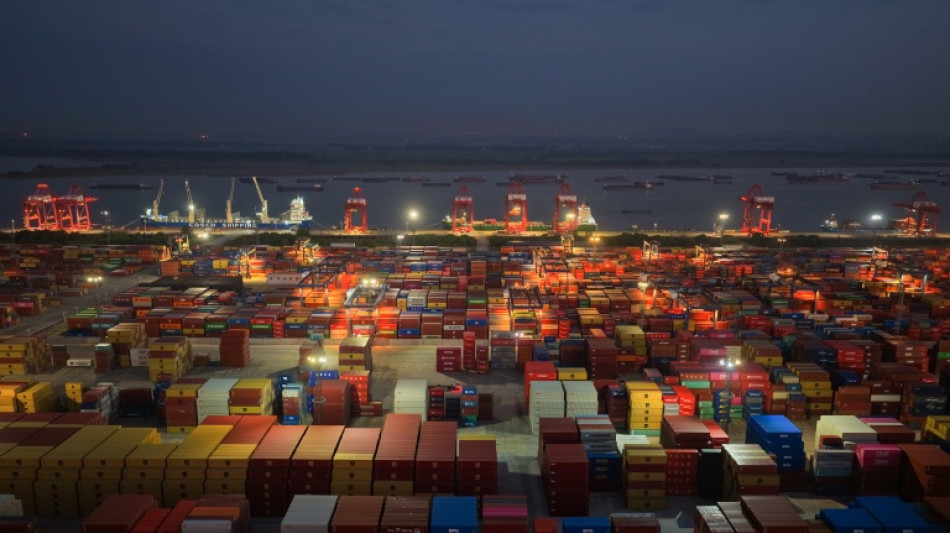
Official data released Wednesday showed China's exports continued their historic surge, providing a much-needed boost to the economy.
However, the vast flow of shipments has also tested relations with major trading partners including the United States and the European Union.
IMF boss Kristalina Georgieva said in Bangkok on Wednesday that China's growth model must "shift from export more towards domestic consumption" in order to address global imbalances.
While exports were the key "booster", the third quarter was "particularly difficult" for China, as retail performance was weak and fixed-asset investment declined, Dan Wang, a director on Eurasia Group's China team, told AFP.
She added that she expected spending in the final quarter "to speed up but only enough to meet the lower bound of (the government's) growth target".
Figures Wednesday showed consumer price inflation remained subdued last month and has been stuck below Beijing's two percent target for more than three years.
Recent measures by Beijing aimed at property sector stabilisation and job creation "form a modest, targeted 'mini-stimulus'", Alicia Garcia-Herrero, Asia-Pacific chief economist at Natixis, told AFP.
"These should support fourth-quarter investment, ease local fiscal stress and help hit the growth target," she said.
The latest steps are mainly concentrated in "strategic infrastructure investment", said Oxford Economics' Yue, meaning that they are "likely to generate weaker near-term employment and income gains than previous stimulus cycles".
"Higher energy prices will add to cost pressures, but excess capacity and soft demand should limit firms' ability to pass these on to consumers," she added.
F. Dumont--BTZ