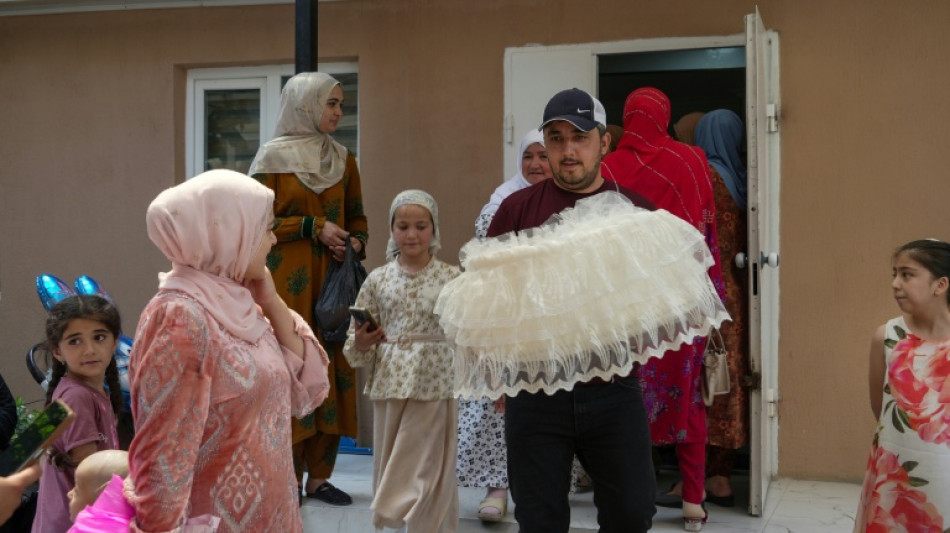
Tajik names for Tajik babies: strict rules leave parents stranded / Photo: © AFP

 London
 17 °C
17 °C
 Manchester
 14 °C
14 °C
 Glasgow
 11 °C
11 °C
 Dublin
19 °C
Dublin
19 °C
 Belfast
18 °C
Belfast
18 °C
 Washington
 19 °C
19 °C
 Denver
 25 °C
25 °C
 Atlanta
 32 °C
32 °C
 Dallas
36 °C
Dallas
36 °C
 Houston Texas
33 °C
Houston Texas
33 °C
 New Orleans
31 °C
New Orleans
31 °C
 El Paso
 33 °C
33 °C
 Phoenix
38 °C
Phoenix
38 °C
 Los Angeles
26 °C
San Diego
25 °C
San Francisco
17 °C
Chicago
18 °C
Minneapolis
16 °C
Seattle
21 °C
Portland
23 °C
Salt Lake City
25 °C
Las Vegas
32 °C
Miami
29 °C
Jacksonville
Los Angeles
26 °C
San Diego
25 °C
San Francisco
17 °C
Chicago
18 °C
Minneapolis
16 °C
Seattle
21 °C
Portland
23 °C
Salt Lake City
25 °C
Las Vegas
32 °C
Miami
29 °C
Jacksonville
 29 °C
San Antonio
36 °C
Bermuda
30 °C
Nassau
20 °C
Iqaluit
3 °C
Yellowknife
19 °C
Anchorage
10 °C
Fairbanks
8 °C
Barrow
1 °C
Calgary
27 °C
Edmonton
33 °C
Winnipeg
20 °C
Goose Bay
13 °C
Halifax
16 °C
Boston
17 °C
Ottawa
14 °C
Toronto
15 °C
Detroit
16 °C
Cleveland
16 °C
New York
21 °C
Baltimore
19 °C
Philadelphia
21 °C
Nuuk (Godthåb)
4 °C
Hong Kong
27 °C
Singapore
27 °C
Melbourne
28 °C
Canberra
9 °C
Adelaide
10 °C
Darwin
24 °C
Perth
12 °C
Fort Worth
37 °C
Honolulu
30 °C
Sydney
14 °C
Johannesburg
15 °C
Dubai
33 °C
Mumbai
29 °C
San Antonio
36 °C
Bermuda
30 °C
Nassau
20 °C
Iqaluit
3 °C
Yellowknife
19 °C
Anchorage
10 °C
Fairbanks
8 °C
Barrow
1 °C
Calgary
27 °C
Edmonton
33 °C
Winnipeg
20 °C
Goose Bay
13 °C
Halifax
16 °C
Boston
17 °C
Ottawa
14 °C
Toronto
15 °C
Detroit
16 °C
Cleveland
16 °C
New York
21 °C
Baltimore
19 °C
Philadelphia
21 °C
Nuuk (Godthåb)
4 °C
Hong Kong
27 °C
Singapore
27 °C
Melbourne
28 °C
Canberra
9 °C
Adelaide
10 °C
Darwin
24 °C
Perth
12 °C
Fort Worth
37 °C
Honolulu
30 °C
Sydney
14 °C
Johannesburg
15 °C
Dubai
33 °C
Mumbai
 27 °C
Zürich
14 °C
Tokyo
25 °C
Seoul
16 °C
Delhi
26 °C
Beijing
15 °C
Riyadh
32 °C
Prague
13 °C
Pennsylvania
19 °C
Valletta
25 °C
Manama
32 °C
Warsaw
10 °C
Stockholm
12 °C
27 °C
Zürich
14 °C
Tokyo
25 °C
Seoul
16 °C
Delhi
26 °C
Beijing
15 °C
Riyadh
32 °C
Prague
13 °C
Pennsylvania
19 °C
Valletta
25 °C
Manama
32 °C
Warsaw
10 °C
Stockholm
12 °C
After giving birth, Shakhnoza Nazarova thought registering her daughter's name would be a mere formality. Instead, her chosen name was rejected -- deemed not Tajik enough by authorities of the Central Asian country.
She is among many parents stuck in a bureaucratic loop -- a government list of approved names designed to promote Tajik culture and curb both the influence of both Russia and radical Islamism.
The register, which excludes any names deemed foreign by officials, was rolled out 10 years ago and last updated in February.
"We had chosen Dunyo. This name was on the list," Nazarova, 30, told AFP in the capital Dushanbe.
"However, when the baby was born and we went to get the birth certificate, the name Dunyo was no longer there" after the update, she said.
A month since her daughter's birth, the mother of three still has no clear answers.
"There's no guidance on what to do when a name isn't on the list. No one accepts our application," she said.
Gurdovarid Mamadjonova, pregnant with her second daughter, faces the same hurdle.
Her ideal name, Yasmina, is not on the list either.
"The Tajik version is Yosuman or Yosamin," said the 27-year-old.
Mamadjonova already had to go with an official name for her first daughter -- "Oisha" instead of her preferred "Aisha" -- has yet to decide whether she "would choose a new name or just go along with whatever they give us again."
- Tajik identity -
In Tajikistan, a secular Muslim country of around 10 million people, longtime President Emomali Rakhmon has sought to redefine the national identity by tightening his grip over Islam and steering the country away from its Soviet legacy.
Proclaimed the "Founder of Peace and National Unity," he casts himself as the guardian of Tajik identity in a country shaped by a bitter 1990s civil war, in which ex-communists defeated an alliance of Islamists and democrats.
A handful of other states also have rules on baby names, but Tajikistan, where the population is surging, goes further than most.
It is "absolutely unacceptable" to "glorify the foreign in the choice of first names," Rakhmon said in 2019.
It "distances future generations from their historical origins," he added.
But what officials count as an acceptable Tajik name is vague.
Some Muslim names are excluded from the official list -- like Yassine, Amira or Riyad -- while others, like Muhammad or Kareem, are permitted.
The rules, which apply only to ethnic Tajiks, collide with deep-rooted Central Asian traditions, where children's names carry great symbolic importance.
Families often coin unique, meaningful names -- combining words that describe the circumstances of birth, a place, or a hoped-for quality in their child.
Badakhshon Tursunova -- born when Tajikistan was still part of the Soviet Union, which suppressed religion -- was named after a region her mother came from.
"One classmate of mine was called Vatan (homeland), another Tabarali (axe)," the 56-year-old woman said.
"After independence, once religion was no longer banned, people began giving their children Muslim names," she said.
- 'Patriotism' -
Worried by the recruitment of Tajiks into jihadist groups and by the Taliban's return to power in neighbouring Afghanistan, Rakhmon has sought to stamp out radical Islam.
"I am proud to be Tajik first, and Muslim second," he is fond of repeating.
Beyond excluding certain Muslim names, authorities have also banned the hijab headscarf for women and outlawed long beards for young men.
Rakhmon has also distanced himself from the country's Soviet past -- though without openly criticising key ally Russia.
In a rare move, he dropped the Russian "-ov" suffix from his own surname back in 2007.
In 2016, he banned it for newborns.
But with Tajikistan being economically dependent on Moscow and hundreds of thousands of Tajik migrant workers living in Russia, practical realities limit the drive to shed Russian influence.
"I had a surge of patriotism and wanted to change my documents and get a Tajik first and last name, without the '-ov' ending," Alisher Rustamov, a Tajik who works in Russia, told AFP.
But amid Russia's strict migration laws, the 45-year-old also wanted to obtain Russian citizenship to ease his daily life there.
Eventually, he gave up the attempted name change due to bureaucratic hurdles.
"It was very complicated and expensive, so I left it as it was."
K. Berger--BTZ