Taiwan blocks key bridge in drill for potential Chinese invasion / Photo: © AFP

 London
 23 °C
23 °C

 Manchester
 20 °C
20 °C
 Glasgow
 23 °C
23 °C
 Dublin
 17 °C
17 °C
 Belfast
18 °C
Belfast
18 °C
 Washington
24 °C
Washington
24 °C
 Denver
15 °C
Denver
15 °C
 Atlanta
24 °C
Atlanta
24 °C
 Dallas
29 °C
Dallas
29 °C
 Houston Texas
31 °C
Houston Texas
31 °C
 New Orleans
30 °C
New Orleans
30 °C
 El Paso
19 °C
El Paso
19 °C
 Phoenix
22 °C
Phoenix
22 °C
 Los Angeles
21 °C
San Diego
21 °C
San Francisco
17 °C
Chicago
Los Angeles
21 °C
San Diego
21 °C
San Francisco
17 °C
Chicago
 17 °C
Minneapolis
19 °C
Seattle
11 °C
Portland
15 °C
Salt Lake City
17 °C
Las Vegas
24 °C
Miami
28 °C
Jacksonville
30 °C
San Antonio
28 °C
Bermuda
28 °C
Nassau
20 °C
Iqaluit
4 °C
Yellowknife
2 °C
Anchorage
17 °C
Minneapolis
19 °C
Seattle
11 °C
Portland
15 °C
Salt Lake City
17 °C
Las Vegas
24 °C
Miami
28 °C
Jacksonville
30 °C
San Antonio
28 °C
Bermuda
28 °C
Nassau
20 °C
Iqaluit
4 °C
Yellowknife
2 °C
Anchorage
 3 °C
Fairbanks
1 °C
Barrow
3 °C
Fairbanks
1 °C
Barrow
 -2 °C
Calgary
7 °C
Edmonton
26 °C
Winnipeg
13 °C
Goose Bay
18 °C
Halifax
18 °C
Boston
18 °C
Ottawa
13 °C
Toronto
19 °C
Detroit
21 °C
Cleveland
21 °C
New York
21 °C
Baltimore
24 °C
Philadelphia
22 °C
Nuuk (Godthåb)
1 °C
Hong Kong
-2 °C
Calgary
7 °C
Edmonton
26 °C
Winnipeg
13 °C
Goose Bay
18 °C
Halifax
18 °C
Boston
18 °C
Ottawa
13 °C
Toronto
19 °C
Detroit
21 °C
Cleveland
21 °C
New York
21 °C
Baltimore
24 °C
Philadelphia
22 °C
Nuuk (Godthåb)
1 °C
Hong Kong
 30 °C
Singapore
26 °C
Melbourne
28 °C
Canberra
9 °C
Adelaide
18 °C
Darwin
27 °C
Perth
14 °C
Fort Worth
28 °C
Honolulu
24 °C
Sydney
16 °C
Johannesburg
11 °C
Dubai
30 °C
Singapore
26 °C
Melbourne
28 °C
Canberra
9 °C
Adelaide
18 °C
Darwin
27 °C
Perth
14 °C
Fort Worth
28 °C
Honolulu
24 °C
Sydney
16 °C
Johannesburg
11 °C
Dubai
 34 °C
Mumbai
27 °C
Zürich
27 °C
Tokyo
18 °C
Seoul
18 °C
Delhi
27 °C
Beijing
16 °C
Riyadh
37 °C
Prague
23 °C
Pennsylvania
24 °C
Valletta
25 °C
Manama
35 °C
Warsaw
19 °C
Stockholm
15 °C
34 °C
Mumbai
27 °C
Zürich
27 °C
Tokyo
18 °C
Seoul
18 °C
Delhi
27 °C
Beijing
16 °C
Riyadh
37 °C
Prague
23 °C
Pennsylvania
24 °C
Valletta
25 °C
Manama
35 °C
Warsaw
19 °C
Stockholm
15 °C
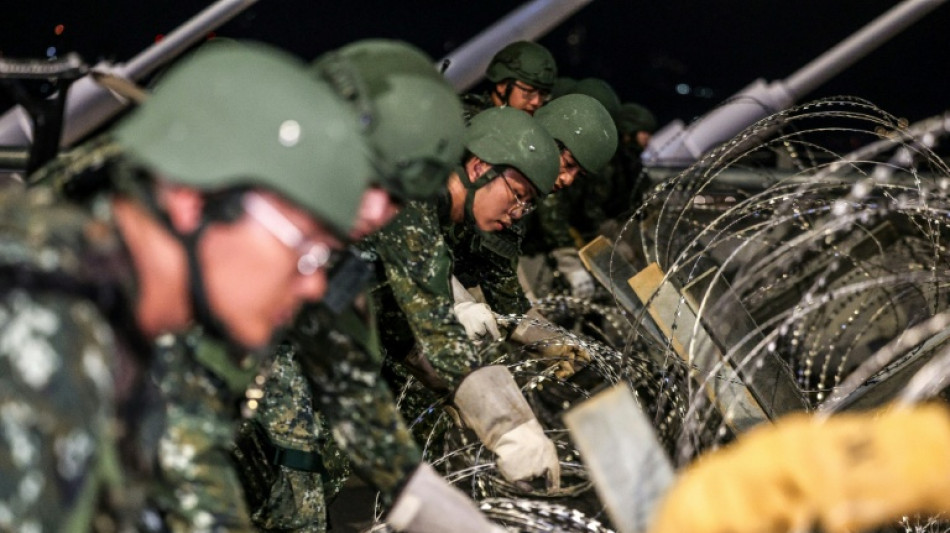
Taiwanese troops used concrete barriers, barbed wire and Hesco walls to block a key bridge near Taipei on Thursday in a drill to stop invading Chinese forces attempting to advance on the capital.
The recently opened Danjiang Bridge that spans the mouth of the Tamsui River was the stage for the night-time exercise held on the second day of Taiwan's annual "Han Kuang" military drills.
China claims Taiwan is part of its territory and has threatened to use force to seize the island of 23 million people.
If China's military, known as the People's Liberation Army (PLA), were to launch an invasion of Taiwan, military experts believe its troops could potentially land on beaches on either side of the Tamsui River and cross the Danjiang Bridge to join forces.
"Once the PLA controls the Danjiang Bridge and both sides of the Tamsui River estuary, that would also mean its troops could advance along both banks of the river," Chieh Chung, an expert on Taiwan's defence policy at Tamkang University, told AFP.
"The goal is simply to prevent the PLA forces from controlling this section of the river, because once they control this stretch of the river, the two landing bases will effectively be linked as one," he said.
To stop them in their tracks, Taiwan's military practised blocking the bridge in an hours-long drill that was to end Friday morning before peak-hour traffic.
Working under the bridge's blue lights, dozens of Taiwanese army combat engineers assisted by cranes and trucks set up layers of concrete and steel barriers, barbed wire and Hesco walls along the nearly one-kilometre-long bridge.
Their aim was not only to slow advancing Chinese forces but to channel them into areas where Taiwanese troops have more firepower.
In the water below, troops deployed fishing nets, floating platforms and barrels that potentially could be filled with explosives during wartime to stop small Chinese vessels entering the river.
Curious locals hoping to catch a glimpse of the spectacle stood on the street in the humid evening air.
"If we ever face an enemy attack, this drill will help us test how to defend it (the bridge), identify any weaknesses and what needs to be improved," Hsu Lien-te, a 75-year-old retired public servant, told AFP.
"That's very important for our country's defence."
- 'We could end up in a war' -
Long-term care manager Kay Li, who had been cycling across the bridge when she was told by the army to leave, said it was "a necessary exercise".
"We could end up in a war," the 37-year-old said.
The drill was held hours after President Lai Ching-te visited the nearby Taipei Port where he observed the loading of missiles and mines onto ships.
On Wednesday night, Lai was put through his paces when he was escorted in an armoured vehicle convoy from the Presidential Office to a secure command centre in a simulated evacuation.
As part of this year's Han Kuang, which ends on August 14, Taiwanese and US-made surface-to-air missile systems were deployed in Taipei.
A key part of this year's exercise is decentralising command and control to enable commanders and officers on the battlefield to make operational decisions without waiting for orders.
U. Schmidt--BTZ