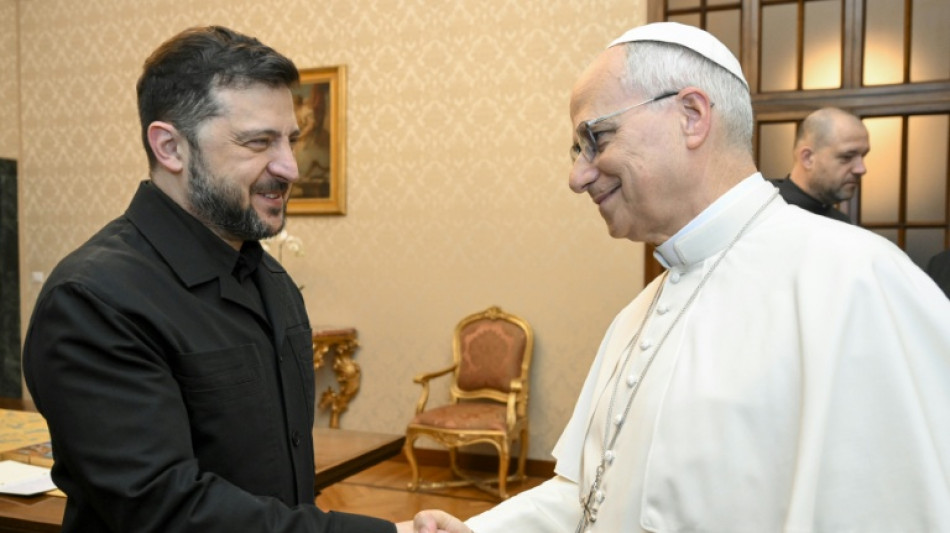
Zelensky says ready to hold Ukraine elections, with US help / Photo: © VATICAN MEDIA/AFP

 London
 16 °C
16 °C

 Manchester
17 °C
Manchester
17 °C
 Glasgow
 12 °C
12 °C
 Dublin
 14 °C
14 °C
 Belfast
13 °C
Belfast
13 °C
 Washington
31 °C
Washington
31 °C
 Denver
 27 °C
27 °C
 Atlanta
29 °C
Atlanta
29 °C
 Dallas
26 °C
Dallas
26 °C
 Houston Texas
 32 °C
32 °C
 New Orleans
 30 °C
30 °C
 El Paso
21 °C
El Paso
21 °C
 Phoenix
34 °C
Phoenix
34 °C
 Los Angeles
35 °C
San Diego
37 °C
San Francisco
22 °C
Chicago
18 °C
Minneapolis
17 °C
Seattle
20 °C
Portland
23 °C
Salt Lake City
27 °C
Las Vegas
33 °C
Miami
31 °C
Jacksonville
25 °C
San Antonio
24 °C
Bermuda
28 °C
Nassau
28 °C
Iqaluit
4 °C
Yellowknife
7 °C
Anchorage
3 °C
Fairbanks
0 °C
Barrow
Los Angeles
35 °C
San Diego
37 °C
San Francisco
22 °C
Chicago
18 °C
Minneapolis
17 °C
Seattle
20 °C
Portland
23 °C
Salt Lake City
27 °C
Las Vegas
33 °C
Miami
31 °C
Jacksonville
25 °C
San Antonio
24 °C
Bermuda
28 °C
Nassau
28 °C
Iqaluit
4 °C
Yellowknife
7 °C
Anchorage
3 °C
Fairbanks
0 °C
Barrow
 -2 °C
Calgary
16 °C
Edmonton
25 °C
Winnipeg
17 °C
Goose Bay
18 °C
Halifax
27 °C
Boston
29 °C
Ottawa
19 °C
Toronto
19 °C
Detroit
-2 °C
Calgary
16 °C
Edmonton
25 °C
Winnipeg
17 °C
Goose Bay
18 °C
Halifax
27 °C
Boston
29 °C
Ottawa
19 °C
Toronto
19 °C
Detroit
 18 °C
Cleveland
16 °C
New York
30 °C
Baltimore
31 °C
Philadelphia
30 °C
Nuuk (Godthåb)
5 °C
Hong Kong
18 °C
Cleveland
16 °C
New York
30 °C
Baltimore
31 °C
Philadelphia
30 °C
Nuuk (Godthåb)
5 °C
Hong Kong
 27 °C
Singapore
28 °C
Melbourne
27 °C
Canberra
13 °C
Adelaide
10 °C
Darwin
27 °C
Singapore
28 °C
Melbourne
27 °C
Canberra
13 °C
Adelaide
10 °C
Darwin
 24 °C
Perth
12 °C
Fort Worth
25 °C
Honolulu
28 °C
Sydney
18 °C
Johannesburg
13 °C
Dubai
33 °C
Mumbai
31 °C
Zürich
18 °C
Tokyo
19 °C
Seoul
9 °C
Delhi
25 °C
Beijing
9 °C
Riyadh
32 °C
Prague
15 °C
Pennsylvania
27 °C
Valletta
24 °C
Manama
33 °C
Warsaw
13 °C
Stockholm
14 °C
24 °C
Perth
12 °C
Fort Worth
25 °C
Honolulu
28 °C
Sydney
18 °C
Johannesburg
13 °C
Dubai
33 °C
Mumbai
31 °C
Zürich
18 °C
Tokyo
19 °C
Seoul
9 °C
Delhi
25 °C
Beijing
9 °C
Riyadh
32 °C
Prague
15 °C
Pennsylvania
27 °C
Valletta
24 °C
Manama
33 °C
Warsaw
13 °C
Stockholm
14 °C
President Volodymyr Zelensky said on Tuesday he was ready to hold new elections in Ukraine provided security could be assured, and that he expected to send Washington within a day revised proposals on ending the nearly four-year war with Russia.
US President Donald Trump is pressuring Kyiv to accept a deal formulated by Washington, the initial version of which was criticised by Ukraine's allies as overly favourable to Russia.
"We are working today (Tuesday) and will continue tomorrow (Wednesday). I think we will hand it over tomorrow," Zelensky told reporters after shuttling between European capitals to hammer out a response with allies.
Trump, who earlier accused Zelensky of not reading the latest US proposals, said Russia had the "upper hand" in the conflict, in an interview with Politico published on Tuesday.
He also accused Kyiv of "using war" to avoid elections, which have been postponed under the imposition of martial law since Russia invaded its neighbour.
"You know, they talk about a democracy, but it gets to a point where it’s not a democracy anymore," Trump said.
Ukrainian law prohibits holding elections under martial law, without which a presidential ballot was to have taken place in March 2024.
But on Tuesday, following Trump's comments, Zelensky said he was ready to organise a new ballot.
"I am ready for the elections," Zelensky told journalists, adding that he was asking Ukrainian lawmakers to prepare "proposals regarding the possibility of amending the legislative foundations and the law on elections during martial law".
He said that, for the vote to take place, security had to be assured in the country whose cities come under Russian drone and missile attacks on a daily basis.
"I am now asking, I declare this openly, for the United States of America to help me, possibly together with European colleagues, to ensure security for holding elections," he said.
- 'No legal right' -
Zelensky spent the past few days shuttling between European capitals to hammer out a response to the US plan. On Monday he held talks with European leaders in London and Brussels. On Tuesday, he went to Italy to meet Pope Leo XIV and Italian Prime Minister Giorgia Meloni.
Washington's proposals involved Ukraine surrendering land that Russia has not captured -- the entire industrial Donbas region -- in return for security promises that fall short of Kyiv's aspirations to join NATO.
Zelensky on Monday said Washington's 28-point plan had been revised to 20 points after US-Ukraine talks at the weekend.
He said the land issue and international security guarantees were two of the main sticking points.
"Do we envision ceding territories? We have no legal right to do so, under Ukrainian law, our constitution and international law. And we don't have any moral right either," Zelensky said.
"The key is to know what our partners will be ready to do in the event of new aggression by Russia. At the moment, we have not received any answer to this question," he said.
During a televised event on Tuesday, President Vladimir Putin called Ukraine's eastern Donbas region Russia's "historical territory".
"This territory is important; it is our historical territory, absolutely," he said.
- Trump criticises Europe -
Trump has blown hot and cold on Ukraine since returning to office in January, initially chastising Zelensky for not being grateful for US support.
But he was also frustrated that efforts to persuade Putin to end the war had failed to produce results, and he recently slapped new sanctions on Russian oil firms.
European allies have expressed solidarity with Ukraine.
Pope Leo XIV said after meeting Zelensky that "The remarks that are made about Europe also in interviews recently, I think, are trying to break apart what I think needs to be a very important alliance today and in the future."
The US pope also warned that "seeking a peace agreement without including Europe in the discussions, let's say, is unrealistic."
"The war is in Europe, and I think that Europe must be part of the guarantees we are seeking for security today and in the future. Unfortunately, not everyone understands this," he said.
H. Müller--BTZ