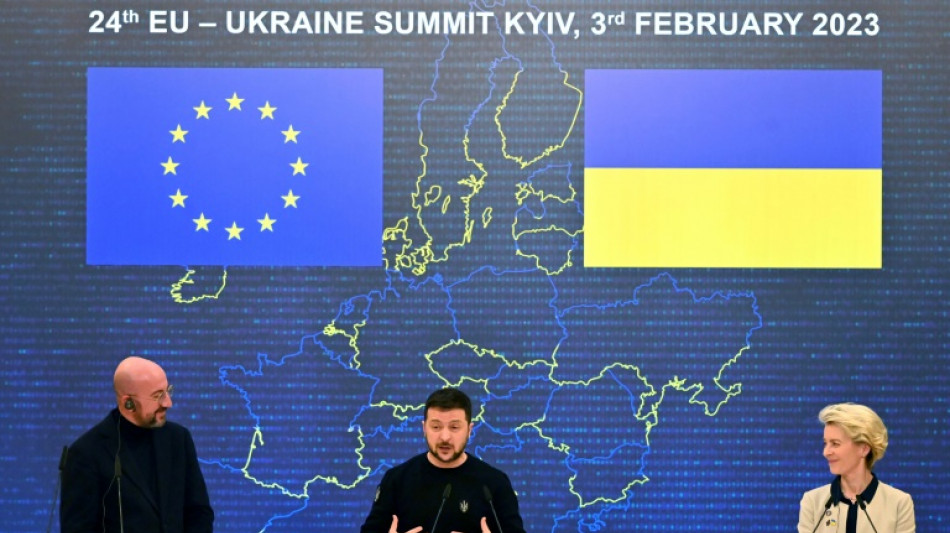
Western allies pledge precision rockets, missile systems to Kyiv / Photo: © AFP

 London
 19 °C
19 °C
 Manchester
16 °C
Manchester
16 °C
 Glasgow
19 °C
Glasgow
19 °C
 Dublin
 15 °C
15 °C
 Belfast
14 °C
Belfast
14 °C
 Washington
15 °C
Washington
15 °C
 Denver
 14 °C
14 °C
 Atlanta
21 °C
Atlanta
21 °C
 Dallas
 22 °C
22 °C
 Houston Texas
24 °C
Houston Texas
24 °C
 New Orleans
26 °C
New Orleans
26 °C
 El Paso
15 °C
El Paso
15 °C
 Phoenix
26 °C
Phoenix
26 °C
 Los Angeles
27 °C
San Diego
26 °C
San Francisco
18 °C
Chicago
13 °C
Minneapolis
13 °C
Seattle
14 °C
Portland
Los Angeles
27 °C
San Diego
26 °C
San Francisco
18 °C
Chicago
13 °C
Minneapolis
13 °C
Seattle
14 °C
Portland
 13 °C
Salt Lake City
17 °C
Las Vegas
23 °C
Miami
28 °C
Jacksonville
25 °C
San Antonio
24 °C
Bermuda
13 °C
Salt Lake City
17 °C
Las Vegas
23 °C
Miami
28 °C
Jacksonville
25 °C
San Antonio
24 °C
Bermuda
 26 °C
Nassau
16 °C
Iqaluit
26 °C
Nassau
16 °C
Iqaluit
 0 °C
Yellowknife
3 °C
Anchorage
0 °C
Fairbanks
-3 °C
Barrow
-3 °C
Calgary
3 °C
Edmonton
15 °C
Winnipeg
10 °C
Goose Bay
7 °C
Halifax
14 °C
Boston
14 °C
Ottawa
5 °C
Toronto
9 °C
Detroit
10 °C
Cleveland
9 °C
New York
16 °C
Baltimore
0 °C
Yellowknife
3 °C
Anchorage
0 °C
Fairbanks
-3 °C
Barrow
-3 °C
Calgary
3 °C
Edmonton
15 °C
Winnipeg
10 °C
Goose Bay
7 °C
Halifax
14 °C
Boston
14 °C
Ottawa
5 °C
Toronto
9 °C
Detroit
10 °C
Cleveland
9 °C
New York
16 °C
Baltimore
 16 °C
Philadelphia
16 °C
Nuuk (Godthåb)
5 °C
Hong Kong
29 °C
Singapore
30 °C
Melbourne
25 °C
Canberra
16 °C
Philadelphia
16 °C
Nuuk (Godthåb)
5 °C
Hong Kong
29 °C
Singapore
30 °C
Melbourne
25 °C
Canberra
 10 °C
Adelaide
13 °C
Darwin
28 °C
Perth
17 °C
Fort Worth
20 °C
Honolulu
25 °C
Sydney
16 °C
Johannesburg
23 °C
Dubai
37 °C
Mumbai
37 °C
Zürich
22 °C
Tokyo
20 °C
Seoul
18 °C
Delhi
36 °C
Beijing
19 °C
Riyadh
40 °C
Prague
20 °C
Pennsylvania
14 °C
Valletta
10 °C
Adelaide
13 °C
Darwin
28 °C
Perth
17 °C
Fort Worth
20 °C
Honolulu
25 °C
Sydney
16 °C
Johannesburg
23 °C
Dubai
37 °C
Mumbai
37 °C
Zürich
22 °C
Tokyo
20 °C
Seoul
18 °C
Delhi
36 °C
Beijing
19 °C
Riyadh
40 °C
Prague
20 °C
Pennsylvania
14 °C
Valletta
 24 °C
Manama
40 °C
Warsaw
21 °C
Stockholm
17 °C
24 °C
Manama
40 °C
Warsaw
21 °C
Stockholm
17 °C
Western allies on Friday pledged precision rockets and missile systems to Ukraine, after President Volodymyr Zelensky called for sophisticated weapons to help retain control of embattled eastern city of Bakhmut.
The European Union agreed to introduce price caps on Russian petroleum products to try to further limit Russian President Vladimir Putin's war chest by targeting his key exports.
The announcements came shortly after Zelensky told a summit with EU leaders in Kyiv: "No-one will surrender Bakhmut. We will fight as long as we can.
"If weapon (deliveries) are accelerated -- namely long-range weapons -- we will not only not withdraw from Bakhmut, we will begin to de-occupy Donbas," he said of the eastern region of Ukraine.
The United States announced a new $2.2-billion package of arms and munitions, which the Pentagon said included a new rocket-propelled precision bomb that could nearly double Kyiv's strike range against Russian forces.
The ground-launched small-diameter bombs (GLSDB), which can fly up to 150 kilometres (93 miles), could threaten key Russian supply lines, arms depots and air bases far behind the front lines.
Ukraine had been asking Washington for munitions that can fly farther than the HIMARS rockets, which have an 80-kilometre range.
The GLSDBs potentially give Kyiv's forces an ability to strike anywhere in the Russian-occupied Donbas, Zaporizhzhia and Kherson regions, and the northern part of occupied Crimea.
The French defence ministry said France and Italy would deliver mobile surface-to-air missile systems in response to an urgent request from Kyiv to help protect "civilian populations and infrastructure from Russian air attacks".
The systems, called MAMBA or SAMP, are a vehicle-mounted battery of medium-range missiles designed to offer protection from airborne threats such as missiles and manned or unmanned aircraft.
Ukrainian Defence Minister Oleksiy Reznikov, who had requested the weapons, tweeted his gratitude, saying they would "help us save thousands of lives" from Russian attacks.
Kyiv is also asking for fighter jets.
It has already secured promises from the West for deliveries of modern battle tanks and after months of hesitation, Germany authorised the delivery of Leopard 1 tanks.
- Targeting Russian refined oil products -
In Brussels, EU negotiators agreed to cap the price of Russian refined oil products to accompany an embargo on ship deliveries of the products that comes into force on Sunday.
Already in December, the EU imposed an embargo on Russian crude oil coming into the bloc by sea and -- with its G7 partners -- imposed a $60-dollar-per-barrel cap on Russian crude exports to other parts of the world.
The price cap sets a ceiling for the cost of Russian oil products transported to third countries on EU ships, to try to prevent Russia circumventing the EU embargo.
European Commission president Ursula von der Leyen estimated this week the crude oil price cap costs Moscow around 160 million euros ($170 million) daily.
The new EU embargo and price caps starting Sunday target Russian refined oil products such as petrol, diesel and heating fuel.
The Kremlin warned that the measures would destabilise world markets.
"This will lead to a further imbalance of the international energy markets," Kremlin spokesman Dmitry Peskov told reporters. "But we are taking measures to hedge our interests against the risks."
- 'No timeline' on EU membership -
At the Kyiv summit, the EU praised Ukraine's "considerable efforts" to start the reforms needed for joining the bloc, but urged it to go further.
Corruption is a key European concern. Ukraine has widened efforts to tackle it, with high profile raids this week on an oligarch with political connections and a former interior minister.
Zelensky, who is pressing for speedy EU accession, suggested Friday that talks could begin this year.
"What exactly did we agree upon today?" Zelensky said in his traditional evening address. "There is an understanding that it is possible to start negotiations on Ukraine's membership in the European Union this year."
But the path to joining the EU could take years.
European Commission president Ursula von der Leyen cautioned that the process was merit-based and there could be "no rigid timelines" on either negotiations or membership itself.
For now, the EU says it will do more to divert Russia's frozen assets for use to compensate Ukraine for damage inflicted since the Russian invasion.
Brussels also plans to roll out a new package of sanctions on the first anniversary of the invasion, on February 24.
- Not a military target -
There was no let-up in fighting in Bakhmut, the frontline of a prolonged battle between Ukrainian and Russian forces.
Throughout Friday morning, AFP journalists heard a steady exchange of small arms fire and the pounding of mortar shells to and from Russian positions.
A charity helping residents said an attack on a car carrying volunteer paramedics had killed one and wounded several others the day before.
Local man Oleksandr Tkachenko, 65, said it was "clear" the car, which was destroyed, was not a military target.
Residents trying to rescue the occupants had also come under attack, he added.
burs/gil/jj
N. Nilsson--BTZ