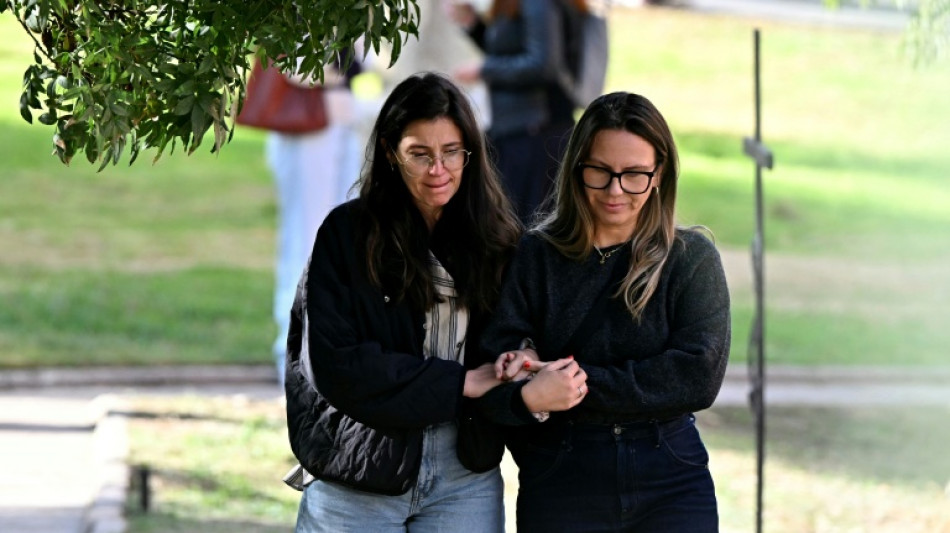
Relatives' anguish grows as Spain identifies train crash dead / Photo: © AFP

 London
 15 °C

 Manchester
14 °C
 Glasgow
 10 °C
 Dublin
16 °C
 Belfast
14 °C
 Washington
 22 °C
 Denver
9 °C
 Atlanta
20 °C
 Dallas
 20 °C
 Houston Texas
24 °C
 New Orleans
23 °C
 El Paso
16 °C
 Phoenix
20 °C
 Los Angeles
18 °C
San Diego
18 °C
San Francisco
14 °C
Chicago
14 °C
Minneapolis
10 °C
Seattle
7 °C
Portland
8 °C
Salt Lake City
12 °C
Las Vegas
18 °C
Miami
29 °C
Jacksonville
23 °C
San Antonio
19 °C
Bermuda
22 °C
Nassau
20 °C
Iqaluit
 -9 °C
Yellowknife
-6 °C
Anchorage
 6 °C
Fairbanks
 3 °C
Barrow
-6 °C
Calgary
 -2 °C
Edmonton
19 °C
Winnipeg
1 °C
Goose Bay
11 °C
Halifax
20 °C
Boston
21 °C
Ottawa
10 °C
Toronto
12 °C
Detroit
11 °C
Cleveland
 14 °C
New York
21 °C
Baltimore
22 °C
Philadelphia
21 °C
Nuuk (Godthåb)
-2 °C
Hong Kong
 26 °C
Singapore
29 °C
Melbourne
28 °C
Canberra
13 °C
Adelaide
18 °C
Darwin
29 °C
Perth
19 °C
Fort Worth
19 °C
Honolulu
25 °C
Sydney
17 °C
Johannesburg
28 °C
Dubai
32 °C
Mumbai
29 °C
Zürich
11 °C
Tokyo
16 °C
Seoul
13 °C
Delhi
19 °C
Beijing
12 °C
Riyadh
 33 °C
Prague
10 °C
Pennsylvania
20 °C
Valletta
20 °C
Manama
31 °C
Warsaw
9 °C
Stockholm
10 °C
Distraught relatives of the 69 victims of Spain's second high-speed train collision this year endured growing anguish on Friday as the authorities worked to identify the bodies.
Wednesday's crash in the central region of Castilla-La Mancha is one of Europe's deadliest rail accidents this century and raised fresh questions about the safety of the world's second-largest high-speed network.
Relatives of the victims, who have been providing DNA samples to help the identification work, face an agonising wait for news as rescue crews sift through the wreckage and bodies are examined in morgues.
Javier Barrio, whose wife Carmen de Santana was caught up in the accident, was among the families staying in the central city of Toledo, where most of the bodies have been taken.
"We are doing what we can, crying. I've got my two children here who are supporting me a lot, but we're having a really hard time," Barrio said.
His wife, who was close to retirement, was making a final work-related trip. Barrio said her death was not confirmed but that the chance of finding her alive was "extremely remote".
Esther San Emeterio, who is awaiting news of her brother, said the "anxiety" her family was experiencing was "crossing a line".
"Last night I went to bed incredibly frustrated, outraged, ashamed that no one is telling us anything."
The army has set up an improvised morgue in Toledo because the city's existing facility could not receive all the corpses.
- 'Working tirelessly' -
Prime Minister Pedro Sanchez assured the affected families that "all branches of the state are working tirelessly... to try to give and provide the most information possible, as soon as possible, reliably."
Castilla-La Mancha's leader Emiliano Garcia-Page warned "we do not rule out there being more dead," saying the emergency services had collected "31 bags of partial remains" that complicated the identification work.
The legal authorities in charge of the process have said 70 reports for missing people have been presented. These could coincide with the bodies, all but five of which remained unidentified.
A Portuguese citizen who worked on one of the trains is among the dead, Portugal's government said on Friday in the first confirmation of a foreign victim.
Another 39 injured people remained in hospital in Castilla-La Mancha, but their evolution was "reasonably positive", Garcia-Page added.
- 'Shattered confidence' -
The accident happened on a key line linking Madrid to the southern city of Seville, which was also the scene of a collision in January that killed 46 people in the region of Andalusia.
Sanchez, who is battling unfavourable polls before a November 29 general election, conceded on Friday that trust in the high-speed network was "shattered" but again vowed to "offer solutions" to avoid further such accidents.
Socialist Transport Minister Oscar Puente rebuffed demands from the right-wing opposition to resign, speaking of his "duty" to improve the system and restore public confidence.
The accident occurred when a service by state operator Renfe ploughed into the back of a stationary train belonging to private Spanish company Iryo outside the village of Urda, around 130 kilometres (80 miles) south of Madrid.
The failure of an automatic safety system called LZB halted all trains on a 63-kilometre stretch of track, but a control centre authorised the Renfe service to resume its journey while the Iryo remained stationary.
I. Johansson--BTZ