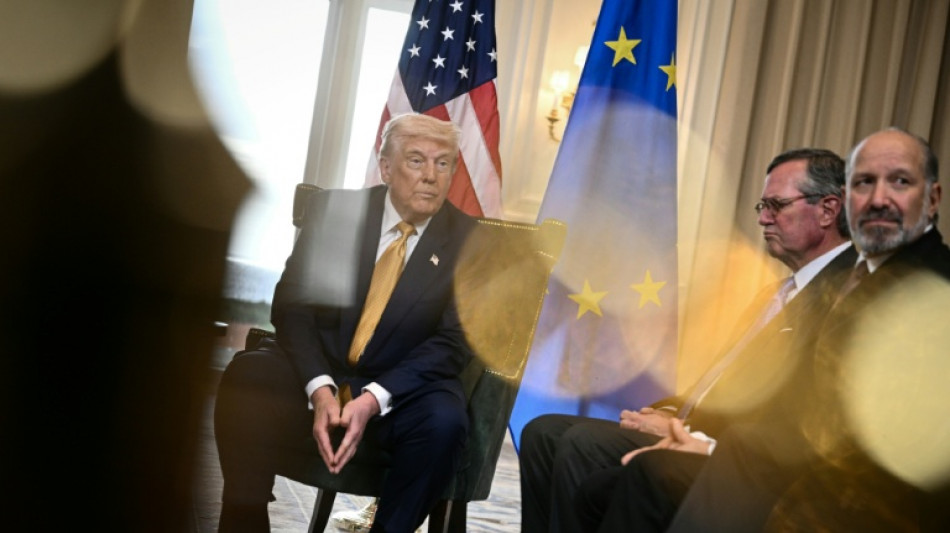
As Trump turns screws, how long can Europe play nice? / Photo: © AFP/File

 London
 19 °C
19 °C

 Manchester
16 °C
Manchester
16 °C
 Glasgow
16 °C
Glasgow
16 °C
 Dublin
 15 °C
15 °C
 Belfast
12 °C
Belfast
12 °C
 Washington
 16 °C
16 °C
 Denver
 17 °C
17 °C
 Atlanta
14 °C
Atlanta
14 °C
 Dallas
 24 °C
24 °C
 Houston Texas
24 °C
Houston Texas
24 °C
 New Orleans
24 °C
New Orleans
24 °C
 El Paso
21 °C
El Paso
21 °C
 Phoenix
29 °C
Phoenix
29 °C
 Los Angeles
22 °C
San Diego
22 °C
San Francisco
14 °C
Chicago
14 °C
Minneapolis
14 °C
Seattle
10 °C
Portland
12 °C
Salt Lake City
20 °C
Las Vegas
Los Angeles
22 °C
San Diego
22 °C
San Francisco
14 °C
Chicago
14 °C
Minneapolis
14 °C
Seattle
10 °C
Portland
12 °C
Salt Lake City
20 °C
Las Vegas
 26 °C
Miami
24 °C
Jacksonville
16 °C
San Antonio
24 °C
Bermuda
24 °C
Nassau
15 °C
Iqaluit
26 °C
Miami
24 °C
Jacksonville
16 °C
San Antonio
24 °C
Bermuda
24 °C
Nassau
15 °C
Iqaluit
 2 °C
Yellowknife
2 °C
Anchorage
9 °C
Fairbanks
5 °C
Barrow
1 °C
Calgary
1 °C
Edmonton
8 °C
Winnipeg
14 °C
Goose Bay
13 °C
Halifax
15 °C
Boston
14 °C
Ottawa
14 °C
Toronto
13 °C
Detroit
12 °C
Cleveland
12 °C
New York
15 °C
Baltimore
15 °C
Philadelphia
14 °C
Nuuk (Godthåb)
2 °C
Yellowknife
2 °C
Anchorage
9 °C
Fairbanks
5 °C
Barrow
1 °C
Calgary
1 °C
Edmonton
8 °C
Winnipeg
14 °C
Goose Bay
13 °C
Halifax
15 °C
Boston
14 °C
Ottawa
14 °C
Toronto
13 °C
Detroit
12 °C
Cleveland
12 °C
New York
15 °C
Baltimore
15 °C
Philadelphia
14 °C
Nuuk (Godthåb)
 -1 °C
Hong Kong
-1 °C
Hong Kong
 30 °C
Singapore
26 °C
Melbourne
18 °C
Canberra
10 °C
Adelaide
16 °C
Darwin
30 °C
Perth
30 °C
Singapore
26 °C
Melbourne
18 °C
Canberra
10 °C
Adelaide
16 °C
Darwin
30 °C
Perth
 18 °C
Fort Worth
24 °C
Honolulu
26 °C
Sydney
13 °C
Johannesburg
24 °C
Dubai
36 °C
Mumbai
32 °C
Zürich
20 °C
Tokyo
22 °C
Seoul
24 °C
Delhi
30 °C
Beijing
27 °C
Riyadh
41 °C
Prague
17 °C
Pennsylvania
16 °C
Valletta
25 °C
Manama
37 °C
Warsaw
18 °C
Stockholm
11 °C
18 °C
Fort Worth
24 °C
Honolulu
26 °C
Sydney
13 °C
Johannesburg
24 °C
Dubai
36 °C
Mumbai
32 °C
Zürich
20 °C
Tokyo
22 °C
Seoul
24 °C
Delhi
30 °C
Beijing
27 °C
Riyadh
41 °C
Prague
17 °C
Pennsylvania
16 °C
Valletta
25 °C
Manama
37 °C
Warsaw
18 °C
Stockholm
11 °C
One headspinning year down, three more to go.
Buffeted by a US superpower turned hostile under Donald Trump, Europe is struggling to set red lines as its once-close ally attacks its laws, eggs on the far-right -- and threatens its sovereignty in Greenland.
Any lingering doubts over the shifting winds in Washington were laid to rest with the release of last month's US security strategy taking most virulent aim not at China or Russia, but at the European Union.
Europe had barely absorbed that shock when it was blindsided by the US president's vow to wrest mineral-rich Greenland from EU and NATO member Denmark -- by force if need be.
European nations scrambled a military mission to Greenland to try to defuse Trump's threat -- but pushing back at the US president is easier said than done.
"Telling Trump 'You can't do that,' is not language that he understands," summed up one EU diplomat, granted anonymity to discuss the sensitive matter.
"We must appease Trump, not poke the beast."
The bottom line is that Europe's hands are tied: the continent is surging defence spending to break its security reliance on the United States -- but for now, it still needs US help to end the Ukraine war, and deter the looming Russian threat to its east.
In that spirit leaders have stopped well short of calling out Trump's threats -- levied right as the Europeans held crunch talks with US envoys on locking in post-war security guarantees for Ukraine.
Instead they have reached for their now-familiar Trump playbook: avoid escalation at all costs, and work to mollify the US president -- until the next time.
The half-dozen Europeans with a direct line to Trump, from France's Emmanuel Macron and Italy's Giorgia Meloni to NATO chief Mark Rutte, can claim some successes with this strategy, namely in clawing back a seat at the table of talks to end the Ukraine war.
But as Denmark's leader Mette Frederiksen warned this week, with three quarters of Trump's presidency left to run, there is reason to expect "the most challenging part" is yet to come.
And Europe may not be able to play nice forever.
- Election tests loom -
Trump's threats to Greenland are just one part of the picture.
Last year's trade standoff with Washington saw Europe strong-armed into what was widely seen as a lopsided deal.
Since then Team Trump has pressed an all-out assault branding Europe's civilisation moribund, imposing sanctions over digital rules it calls censorship, and vowing to boost political forces aligned with the president's MAGA ideology.
Strongman Viktor Orban can expect the weight of US foreign policy behind him in Hungary's April elections, with Elon Musk's X acting as a force multiplier for hard-right narratives.
And France's 2027 election looms as a key test.
Trump's camp has "formulated quite clearly" it would welcome a far-right win in the nuclear-armed EU heavyweight, said Tara Varma, European policy expert at the German Marshall Fund of the United States.
"We have to take them at their word," she warned, saying Europe needs to rethink tools designed to counter political meddling from regimes like Russia -- to meet the new US threat.
- A 'bazooka' for Greenland? -
The spectre of MAGA-fuelled interference feeds into the critical issue of whether the EU has the mettle to keep US tech giants in check.
So far the EU has stared down threats of US retaliation to keep enforcing its laws against online abuses and disinformation, with fines on X and others.
But even penalties in the hundreds of millions are seen as small fry for the likes of Musk -- who pours expletive-laden scorn on the EU and its rules.
So what more can Europe do to try to turn the tables?
Simple, say advocates of tougher action: play the economic card, as America's biggest bilateral trade partner.
When it comes to Greenland, European law professor Alberto Alemanno says the bloc's "most tangible threat" to deter Trump is freezing the US trade deal -- an idea gaining ground in the EU parliament.
The tough question is where to draw the line.
"Do we need the territorial integrity of the European Union to be breached? Do we need to see boots on the ground, to see the Americans entering into Greenland, in order to justify this?" asked Alemanno.
Beyond that, the bloc has a powerful weapon called the anti-coercion instrument -- never used before -- that allows for curbing imports of goods and services and has been invoked as a way to push back over tech and trade, and now Greenland.
Deploying the trade "bazooka," as it is dubbed, is one idea being brainstormed in Brussels but still seen as a long shot.
"Europe has a number of cards up its sleeve -- and it's chosen consciously or unconsciously not to use them," said the German Marshall Fund's Varma.
But at some point, she warned, "it might have to."
A. Williams--BTZ