'Like we were on a trampoline': Indonesia quake kills 20, thousands flee / Photo: © AFP

 London
 10 °C
10 °C

 Manchester
 8 °C
8 °C
 Glasgow
 10 °C
10 °C
 Dublin
10 °C
Dublin
10 °C
 Belfast
9 °C
Belfast
9 °C
 Washington
 7 °C
7 °C
 Denver
 13 °C
13 °C
 Atlanta
12 °C
Atlanta
12 °C
 Dallas
17 °C
Dallas
17 °C
 Houston Texas
19 °C
Houston Texas
19 °C
 New Orleans
19 °C
New Orleans
19 °C
 El Paso
 18 °C
18 °C
 Phoenix
19 °C
Phoenix
19 °C
 Los Angeles
16 °C
San Diego
17 °C
San Francisco
13 °C
Chicago
13 °C
Minneapolis
18 °C
Seattle
6 °C
Portland
6 °C
Salt Lake City
8 °C
Las Vegas
17 °C
Miami
22 °C
Jacksonville
16 °C
San Antonio
17 °C
Bermuda
24 °C
Nassau
8 °C
Iqaluit
-5 °C
Yellowknife
-4 °C
Anchorage
0 °C
Fairbanks
-9 °C
Barrow
-3 °C
Calgary
Los Angeles
16 °C
San Diego
17 °C
San Francisco
13 °C
Chicago
13 °C
Minneapolis
18 °C
Seattle
6 °C
Portland
6 °C
Salt Lake City
8 °C
Las Vegas
17 °C
Miami
22 °C
Jacksonville
16 °C
San Antonio
17 °C
Bermuda
24 °C
Nassau
8 °C
Iqaluit
-5 °C
Yellowknife
-4 °C
Anchorage
0 °C
Fairbanks
-9 °C
Barrow
-3 °C
Calgary
 -2 °C
Edmonton
7 °C
Winnipeg
17 °C
Goose Bay
5 °C
Halifax
-1 °C
Boston
4 °C
Ottawa
1 °C
Toronto
3 °C
Detroit
-2 °C
Edmonton
7 °C
Winnipeg
17 °C
Goose Bay
5 °C
Halifax
-1 °C
Boston
4 °C
Ottawa
1 °C
Toronto
3 °C
Detroit
 7 °C
Cleveland
8 °C
New York
9 °C
Baltimore
5 °C
Philadelphia
7 °C
Nuuk (Godthåb)
7 °C
Cleveland
8 °C
New York
9 °C
Baltimore
5 °C
Philadelphia
7 °C
Nuuk (Godthåb)
 -4 °C
Hong Kong
-4 °C
Hong Kong
 30 °C
Singapore
27 °C
Melbourne
19 °C
Canberra
30 °C
Singapore
27 °C
Melbourne
19 °C
Canberra
 21 °C
Adelaide
19 °C
Darwin
32 °C
Perth
17 °C
Fort Worth
16 °C
Honolulu
24 °C
Sydney
23 °C
Johannesburg
26 °C
Dubai
34 °C
Mumbai
34 °C
Zürich
7 °C
Tokyo
17 °C
Seoul
16 °C
Delhi
32 °C
Beijing
14 °C
Riyadh
34 °C
Prague
21 °C
Adelaide
19 °C
Darwin
32 °C
Perth
17 °C
Fort Worth
16 °C
Honolulu
24 °C
Sydney
23 °C
Johannesburg
26 °C
Dubai
34 °C
Mumbai
34 °C
Zürich
7 °C
Tokyo
17 °C
Seoul
16 °C
Delhi
32 °C
Beijing
14 °C
Riyadh
34 °C
Prague
 11 °C
Pennsylvania
4 °C
Valletta
22 °C
Manama
33 °C
Warsaw
11 °C
Stockholm
10 °C
11 °C
Pennsylvania
4 °C
Valletta
22 °C
Manama
33 °C
Warsaw
11 °C
Stockholm
10 °C
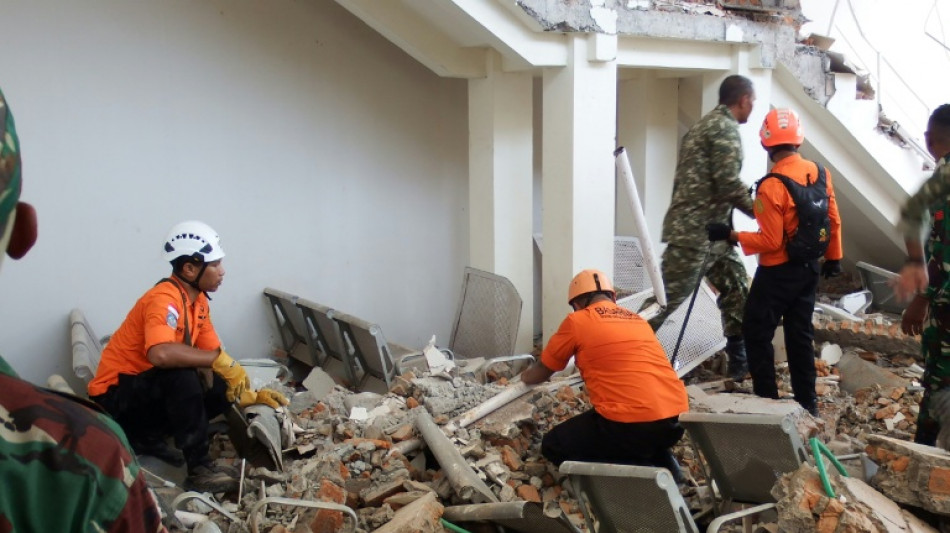
Rescuers combed through debris for survivors Saturday after a powerful earthquake struck off Flores island in eastern Indonesia, killing 20 people and sending thousands fleeing.
Rescue official Fathur Rahman told AFP at least 20 people were confirmed dead on the popular tourist island and six others reported injured.
At least two people were known to be trapped alive under rubble following the 7.7-magnitude quake, he said.
"I have never felt an earthquake this big," Yulian Juita Ekalia, who lives in Ruteng city more than 100 kilometres (60 miles) west of the epicentre, told AFP by telephone.
"It felt like we were on a trampoline; it was really scary," said the 37-year-old university lecturer, who jolted awake at around 5:30 am (2130 GMT on Friday).
"As I rushed to get outside, everything in the house fell down: the television, my son's trophies, the dish racks, suitcases on top of the wardrobes. When I got outside, my son and neighbours were already there, screaming in fear."
Fathur said the focus has shifted to locating victims who may be buried under rubble, but rescue efforts have been complicated by landslides cutting off roads.
Residents in Nagekeo, an area close to the epicentre, raced for higher ground as the sea retreated early Saturday -- a possible sign of an approaching tsunami, AFP journalists witnessed.
While a tsunami warning was lifted, authorities urged people not to return to damaged buildings for fear that aftershocks may bring them down.
Many remained outside by lunchtime as dozens of aftershocks continued shaking the island, the strongest measured at a magnitude of 6.1.
- 'Panicking' -
Yulian said she had dragged her stove outside and was cooking there, fearing further tremors.
Outside a nearby hospital, she said she saw patients being treated under emergency tents.
Seeing images online of her university badly damaged, Yulian said she was "grateful that the quake happened on a Saturday morning when there was no campus activity... I can't imagine what it would have been like if it happened while we were all there."
Nagekeo resident Yohanes Babo, 56, said he was at a market when the earth started shaking in the early morning.
"The shaking was strong. Thankfully, we were already outside the house," he told AFP.
"People were panicking, running here and there. We're evacuating for the time being... and trying to get to the hills," he said.
The epicentre of the shallow quake was located just off the north coast of the island, US and Indonesian authorities said.
The extent of the damage is still being assessed. The area is largely rural with few, if any, high-rise buildings.
Lukas Lotar, a hospital customer service official in Maumere on the same island, said some patients fled.
"The jolt was big. I saw some walls were cracked," he told AFP.
- 'Ring of Fire' -
Long queues of people could be seen evacuating on foot, by motorbike and car, some piled into the back of pickup trucks, after the initial tsunami warning issued by Indonesia's Meteorology, Climatology, and Geophysics Agency.
Indonesia experiences frequent earthquakes due to its location in the Pacific "Ring of Fire", an arc of intense seismic activity stretching from Japan through Southeast Asia and across the Pacific basin.
Flores was struck by a 7.7-magnitude earthquake in 1992, which triggered a tsunami and resulted in around 2,500 deaths.
A devastating 9.1-magnitude tremor in 2004 struck off the coast of Sumatra and triggered a tsunami that killed 220,000 throughout the region, about 170,000 of them in Indonesia, in one of the deadliest natural disasters in recorded history.
In 2018, a powerful quake shook the holiday island of Lombok followed by several more tremors, killing over 550 people.
Later that year, a 7.5-magnitude quake and a subsequent tsunami on Sulawesi island left more than 4,300 people dead or missing.
A. Lefebvre--BTZ